









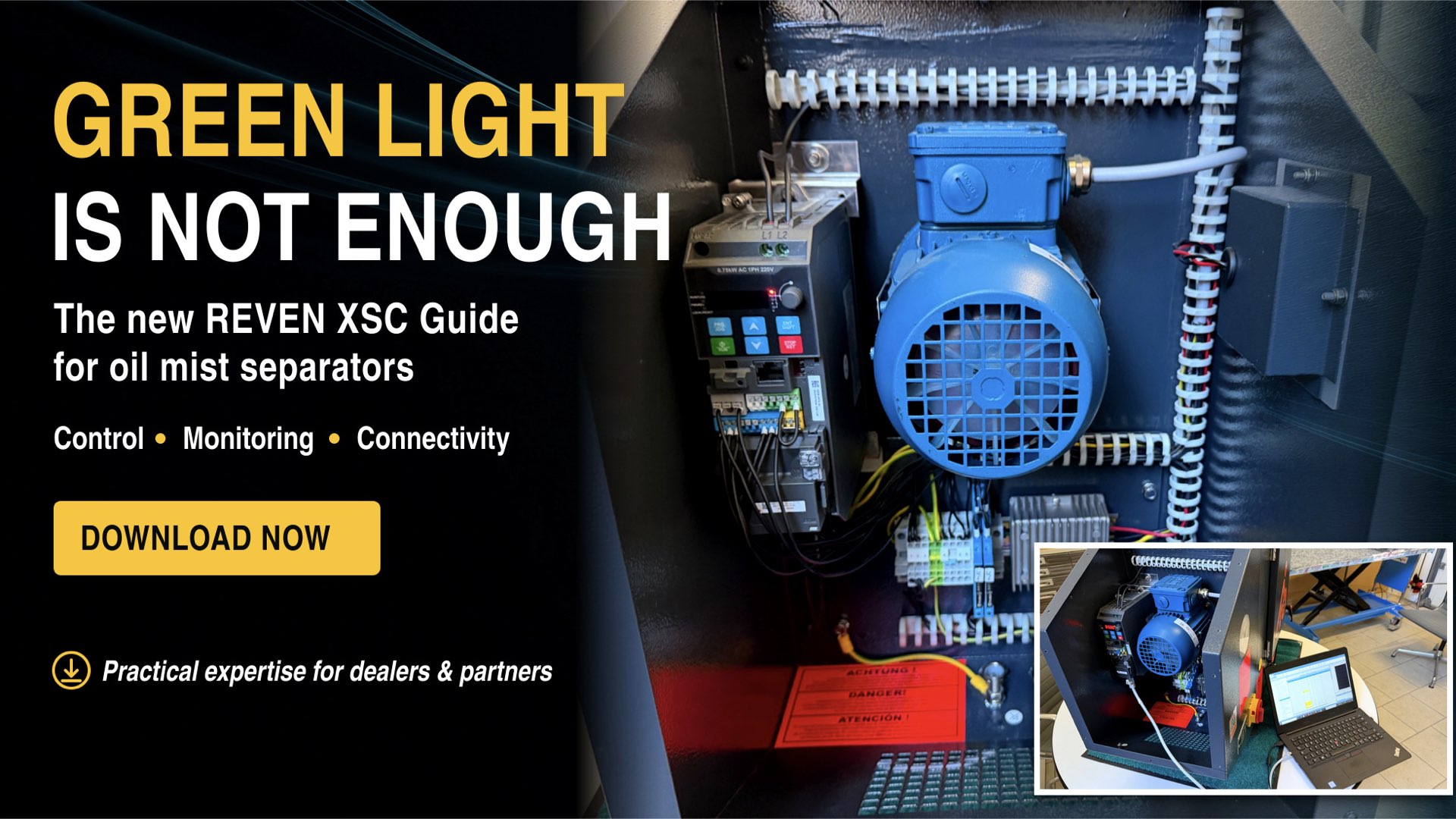
A green light isn’t enough: The new REVEN XSC Guide for oil mist separators. An industrial air purifier can be running but still not operating at its best. The fan is running, but the separator may be clogged. Or a door on the machine tool may be open, which is altering the airflow. A restricted air path can also affect performance. So the unit continues to run, but its actual operating condition has changed significantly.
This is exactly where the REVEN X-CYCLONE® Speed Control—or XSC for short—comes in. It monitors key operating parameters and displays changes using a simple traffic-light system. To help users better understand and properly use this technology, we’ve created the new REVEN XSC Guide for oil mist separators.
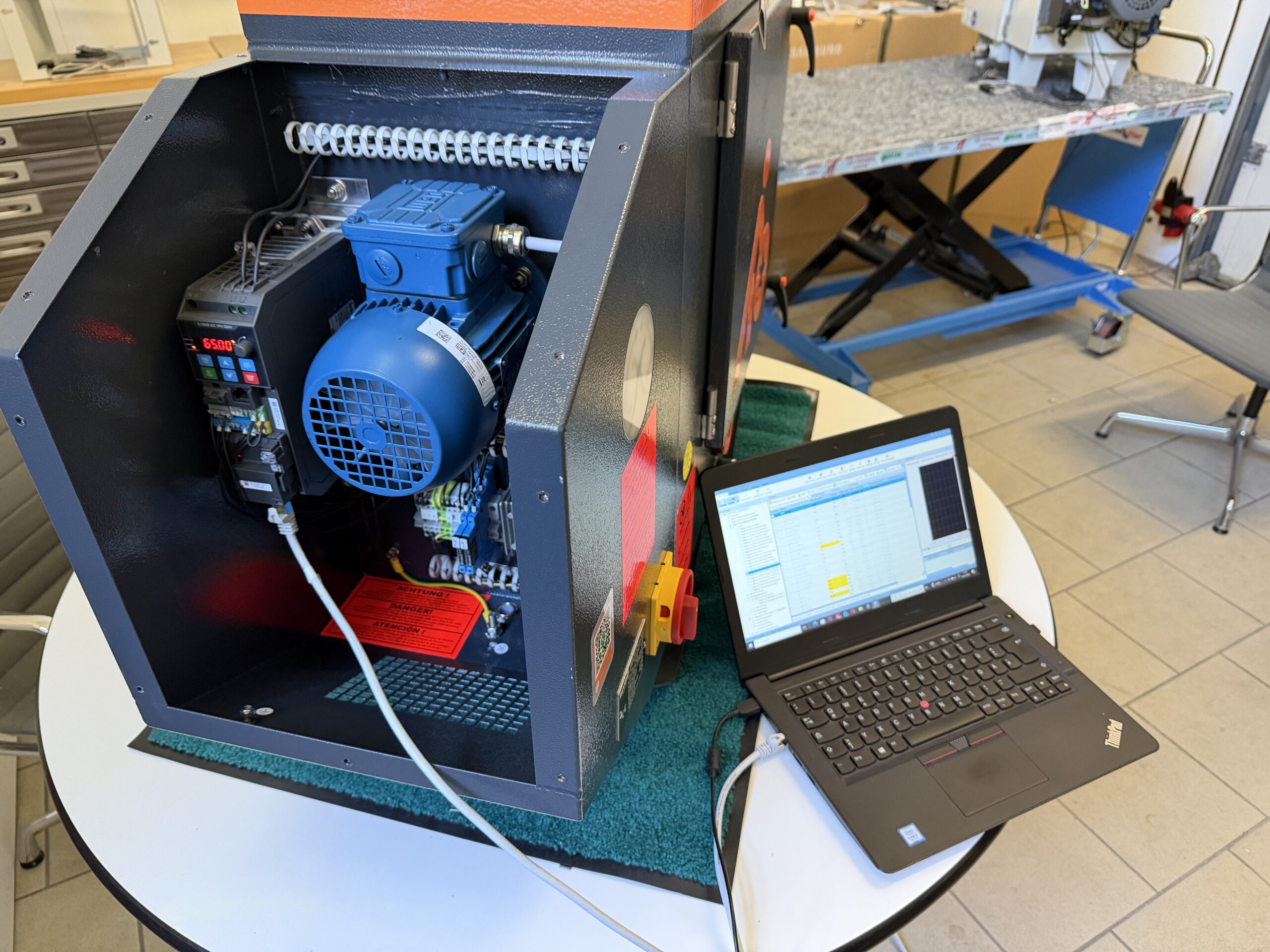
The guide explains the technology in easy-to-understand language, while also going into great detail on the key aspects. Operators, planners, service technicians, and machine manufacturers will therefore find it a practical reference guide for everyday use.
Why We Created the New XSC Guide
Modern air purifiers are designed to filter effectively, but they should also operate as efficiently as possible. That’s why it’s not enough to simply check whether the fan is running. Operators want to know whether the operating status has changed and whether an inspection is necessary.
We have introduced the basic principle. Since then, we have further developed the technology, gained practical experience, and explored new ways to communicate.
This raised many questions:
- What does the XSC actually measure?
- What do green, yellow, and red mean?
- How does the system detect a dirty separator?
- What role does the variable-frequency drive play?
- How can the control system be connected to a higher-level system?
- What data is available for service and building management systems?
- And what are the technical limitations?
The new guide provides clear and detailed answers to these questions. To do so, we’ve drawn on our expertise in development, application, and service. We’ve also analyzed an in-depth expert interview with Sven Rentschler, Zoltan Kiss, and Oliver Schäfer. In addition, we reviewed the technical documentation for the new REVEN frequency converter and the optional communication module.
The result was a 44-page guide featuring numerous photos and a total of 80 questions covering both technical and practical topics.
What does XSC technology monitor?
The XSC monitors the operating status of the air purifier. To do this, it evaluates, among other things, the fan’s frequency and motor current. It then classifies these values based on a device-specific REVEN characteristic curve.
This is important because power consumption and frequency change when conditions in the air system change. A dirty separator can increase resistance. An open machine door can alter the airflow path. A closed damper or a restriction in the ductwork can also affect operating parameters.
The XSC therefore detects the effect of a change. However, it cannot automatically determine the specific cause in every case. If the reading deviates, a service technician will therefore inspect the entire system.
In addition, the XSC does not measure airflow directly. It therefore does not function like a calibrated airflow meter. Instead, it evaluates electrical operating parameters and uses them to detect deviations from the specified operating range.
This clear distinction is important because it enables users to understand and use the display correctly.
Green, Yellow, and Red: A Simple Explanation
The traffic-light display quickly shows the current status. It helps the operating staff because no one has to spend time analyzing long lists of measurement values or parameters first.
Green means:
The air purifier is operating within the defined operating range. The monitored values are reasonable, and there are no notable deviations. However, green does not automatically mean that every single component of the entire system is fault-free.
Yellow means:
The XSC has detected an anomaly. The air purifier can continue to operate, but the operator should check the status. Perhaps the filter is becoming increasingly clogged, or a change in the airflow is affecting the system.
Red means:
The values deviate significantly from the specified range. Action is now required, and therefore a qualified person should inspect the system.
The traffic light system thus provides a quick overview. At the same time, it supports condition-based maintenance because the operator does not rely solely on a fixed schedule. Instead, the operator can respond to the actual condition of the equipment.
However, XSC does not promise to accurately predict future failures. True predictive maintenance would require longer time series, additional analyses, and clearly defined forecasting models.
Why a Constant Air Velocity Is Important
An oil mist separator requires the proper flow conditions to operate reliably. If the air velocity is too low, separation efficiency may decrease. If it is too high, energy consumption may increase unnecessarily, and the overall system may be subjected to greater stress.
The XSC therefore supports operation that is as stable as possible. It monitors changes and adjusts fan output within the specified control strategy.
For more information about the devices and their applications, please visit our overview page for the REVEN X-CYCLONE® oil mist separators.
The Frequency Converter as a Key Interface
The frequency converter controls the fan motor and simultaneously provides important operating data. It therefore serves as a central link between the fan, the XSC logic, and optional communication.
In the new guide, we explain, among other things:
- what function the frequency converter performs,
- how the key parameters interact,
- why proper parameterization is crucial,
- how acceleration and deceleration ramps work,
- how motor current and frequency are measured,
- and what instructions must be followed during startup and maintenance.
The new version, featuring the new frequency converter, is currently in the pre-production phase. REVEN is therefore carefully testing the parameters, interfaces, and performance under real-world operating conditions. Approval for mass production will be granted only after these tests have been completed.
The guide documents the state of technical development as of July 29, 2026. It clearly distinguishes between existing features, optional equipment, and possibilities still to be evaluated.
Optional Communication with Upper-Level Systems
Many operators don’t just want to view operating data directly on the air purifier. They also want to display the readings in a machine control system, a control room, or a maintenance system.
To this end, the frequency converter can be optionally equipped with an industrial Ethernet communication module. The manufacturer’s documentation describes various communication protocols. However, REVEN specifically verifies which protocols and data points will actually be enabled later on.
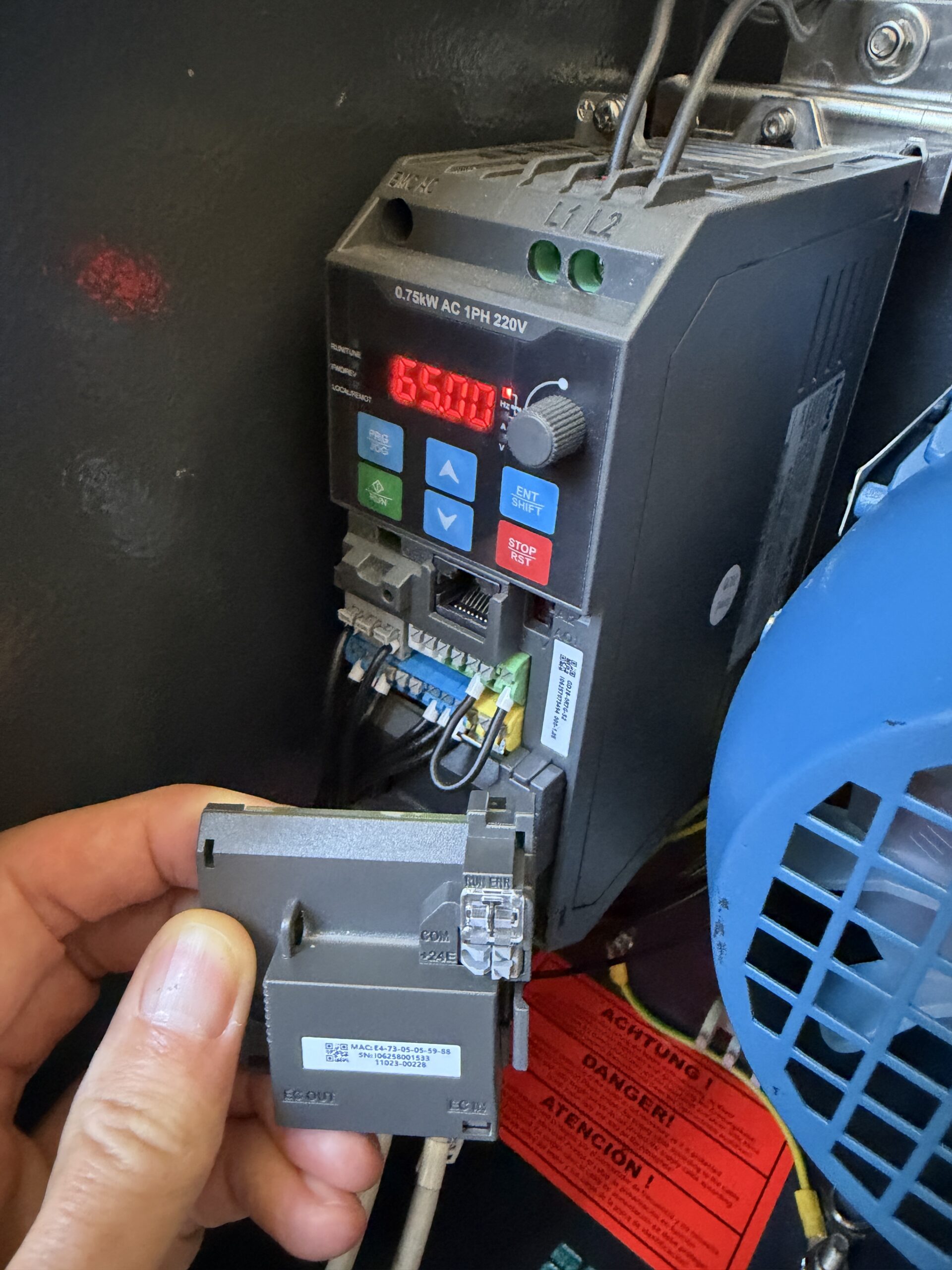
Depending on the final design, the following information, for example, may be relevant:
- Operational readiness,
- current frequency,
- Motor current,
- Operating status,
- Warning or malfunction,
- and selected diagnostic values.
An important principle applies here: A feature that the manufacturer describes in general terms is not automatically included in the released REVEN version. For this reason, the guide clearly indicates which features are available and which are still undergoing technical testing.
You can also find a general overview of our solutions on the REVEN page dedicated to control and regulation technologies.
The guide also answers difficult practical questions
During daily operation, questions often arise that cannot be addressed in a brief data sheet. That is why the XSC Guide does not just cover the basic functions; it also addresses typical situations that arise during installation, commissioning, maintenance, and troubleshooting.
For example, the guide explains what happens when the machine doors are open and why this can cause operating parameters to change. It also describes how an increasingly dirty separator becomes noticeable and what steps to take if the indicator shows yellow or red.
Topics such as fire suppression systems, butterfly valves, external approvals, and restarting after a malfunction are also covered. At the same time, the guide explains the limitations of remote diagnostics, since not every cause can be reliably determined based on a single data point alone.
In this way, the guide helps the operator act more quickly and with greater precision. At the same time, it supports service technicians by explaining important concepts in a clear and understandable way.
Who is the new REVEN XSC Guide designed for?
This guide is intended for anyone who selects, operates, or maintains industrial air purifiers.
These include, in particular:
- Operators of machine tools and production equipment,
- Maintenance personnel and service technicians,
- Machinery manufacturers and plant builders,
- Electrical Designers and Automation Technicians,
- Specialist in industrial ventilation,
- as well as those responsible for occupational health and safety and plant safety.
Beginners will find an easy-to-understand introduction, while experienced professionals will find plenty of technical details and practical tips.
Knowledge provides peace of mind and saves time
A good control system can only deliver its full benefits if users understand its displays correctly. That is why the new XSC Guide does more than just explain what the technology can do; it also explains what it cannot do and when an expert inspection is necessary.
The guide thus facilitates clear communication between the operator, service provider, machine manufacturer, and planner. It also simplifies commissioning and assists with systematic troubleshooting.
Those who understand the interrelationships can react more quickly. And those who respond to changes early on can avoid unplanned downtime and keep the air purifier operating within the appropriate range at all times.
Download the new XSC Guide for free now
Would you like to better understand XSC technology and have the many answers at your fingertips at any time?
Then download the complete REVEN XSC Guide for Oil Mist Separators as a PDF now:
- 📗 🇬🇧 English Download
- 📗 🇫🇷 French Download
- 📗 🇮🇹 Italian Download
- 📗 🇭🇺 Hungarian Download
- 📗 🇪🇸 Spanish Download
- 📗 🇷🇴 Romania Download
- 📗 🇨🇳 Chinese Download
- 📗 🇧🇷 Brazilian Download
The guide contains 44 pages of technical explanations, practical questions, images, safety instructions, and information on the current state of development.
If you have any questions about XSC technology or a specific application, please feel free to contact us. Together, we’ll determine which model is best suited for your machine tool and your exhaust system.