









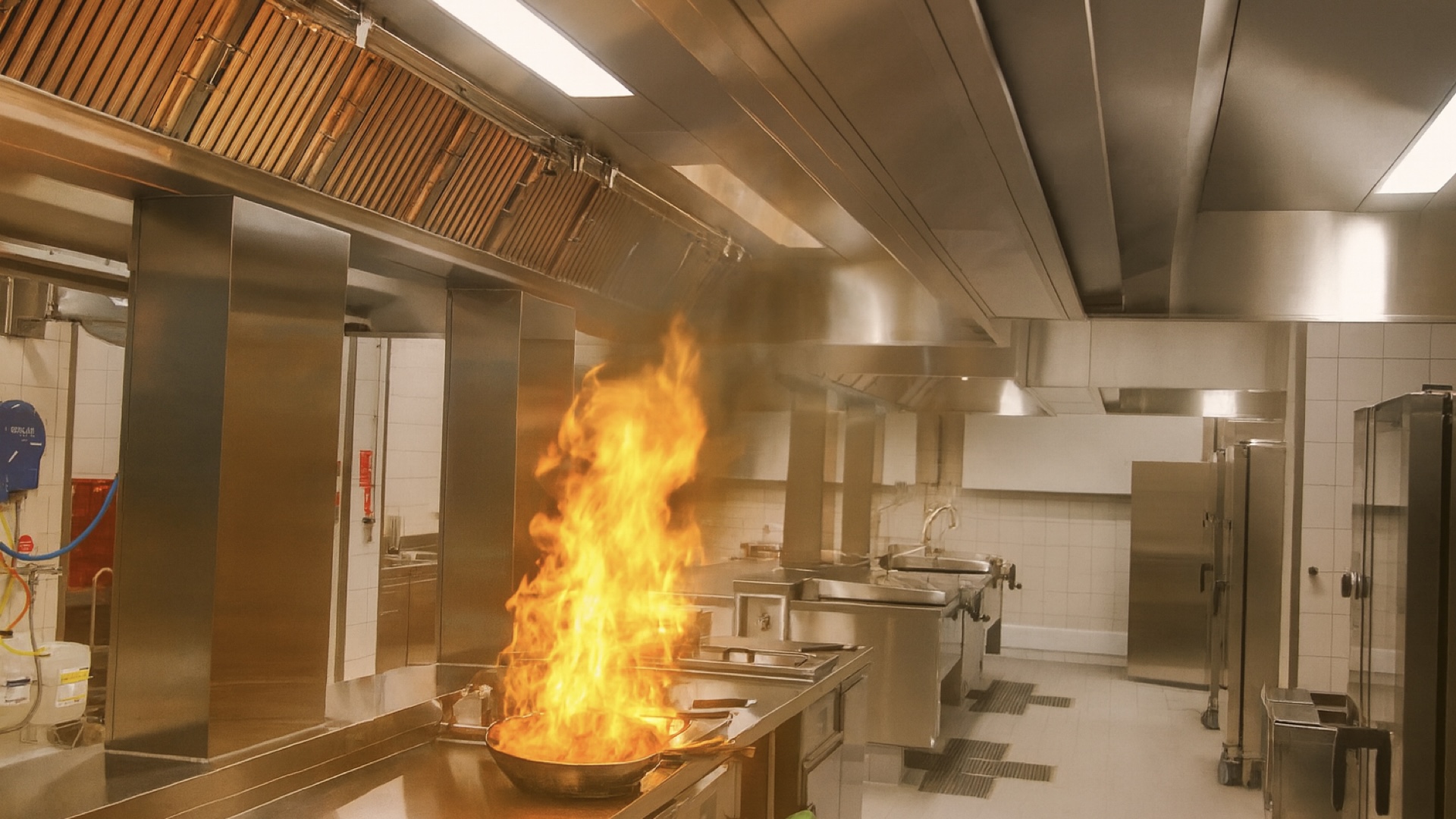
Why fire extinguishing systems are indispensable in commercial kitchens – There are enormous fire hazards in commercial kitchens every day. Oil and fat ignite extremely quickly. Even a small pot can trigger a dangerous explosion. When there’s a fire, it’s not just about property damage, it’s about human lives. Every second counts, especially in care homes, hospitals or nurseries. There can be no compromises here.
Portable extinguishers or fixed fire extinguishing systems in commercial kitchens?
Many operators ask themselves: Is a fire extinguisher or a fire blanket enough? The answer is a clear no. DIN EN 16282 stipulates this: As soon as a fire extinguishing system is installed, it must protect any cooking appliance that poses a fire hazard. This includes all appliances that work with oil or fat, regardless of the filling quantity!
The old rule of thumb “you only need an extinguishing system for 50 liters of oil or more” no longer applies. Even a small glass full of hot fat can cause a fat explosion.
Limits of portable fire extinguishers and fire blankets
- Fire blankets cannot withstand the heat of grease fires. They can even burn through.
- Fire extinguishers do extinguish the flame, but they do not switch off the energy source. The fire can flare up again immediately.
Download an old PDF report on tests of fire blankets for grease fires*:
*Newer and more recent tests of fire blankets by Stiftung Warentest from 2015 and 2017 confirmed the behavior described in the PDF!
A stationary fire extinguishing system in commercial kitchens works in a completely different way: it automatically detects the fire, extinguishes it within seconds and switches off the gas or electricity. This reliably prevents the fire from breaking out again.
Sprinkler systems in kitchens – a dangerous mistake
Many buildings are equipped with central sprinkler systems. If these are simply pulled through the kitchen, there is an enormous risk. If sprinkler water meets hot grease, it explodes! This endangers everyone in the room.
The only safe solution: special sprinkler covers that direct the water away from the cooking block. But one thing is also clear: sprinklers are no substitute for a fire extinguishing system in commercial kitchens.
Practical recommendation: When do you need a fire extinguishing system?
Our recommendation is clear: as soon as a kitchen works with oil or grease, it needs a fixed fire extinguishing system. Anything else means risk.
If you decide not to install an extinguishing system, you should have this decision confirmed in writing by a fire protection expert or chimney sweep. This is the only way to stay on the safe side legally and in terms of safety.
Advantages of stationary fire extinguishing systems in commercial kitchens
- They detect fires in seconds.
- They extinguish automatically with a grease fire extinguishing agent.
- You switch off the gas or electricity immediately.
- They reliably prevent personal injury.
- They meet the requirements of DIN EN 16282.
Test stand for flame transmission testing in accordance with DIN EN 16282
And never forget: The separators in kitchen ventilation systems, i.e. the kitchen filters or flame protection filters, must also be tested. For this purpose, video recordings and images of the flame transmission test stand in accordance with DIN EN 16282 must be published:
For more information download our new X-CYCLONE separation guide:
Conclusion on fire extinguishing systems in commercial kitchens
Does every kitchen need a fire extinguishing system?
No. But as soon as oil or grease is used, we strongly recommend it.
Is a portable fire extinguisher enough?
No. Portable extinguishers only help on a small scale. They do not replace a stationary system.
Are sprinklers allowed in kitchens?
Yes, but only with special facings. Without this adaptation, sprinklers are extremely dangerous.
Conclusion: Fire extinguishing systems in commercial kitchens save lives because they extinguish fires immediately, prevent explosions and protect employees and guests. Those who plan professionally rely on a stationary fire extinguishing system from the outset and take no risks.