









Inhaltsverzeichnis
- Listen to the podcast
- Why do so many misunderstandings arise in ventilation technology?
- The typical misconceptions from the ventilation technology book & podcast at a glance
- From podcast to ventilation technology book and back again
- Conclusion on the misunderstandings in ventilation technology
- Follow us on social media
Misunderstandings about ventilation technology: what many people get wrong. In practice, many misunderstandings in ventilation technology lead to incorrect assumptions about extraction, air purification and air flows. Although the topic is omnipresent, central physical relationships are often underestimated or misinterpreted.
Many people think they know how ventilation works. After all, we encounter this topic every day – whether in the kitchen, in the office or in industry.
But if you take a closer look, it quickly becomes clear:
There are an astonishing number of misconceptions about ventilation technology and air pollution control.
These misunderstandings in ventilation technology are particularly evident in practice.
This is exactly what our latest podcast episode of “Luftpost” is all about.
The special thing about it:
The content is based on our specialist book “Misunderstandings in ventilation technology and air pollution control” and has been converted back into a podcast format with the help of AI.
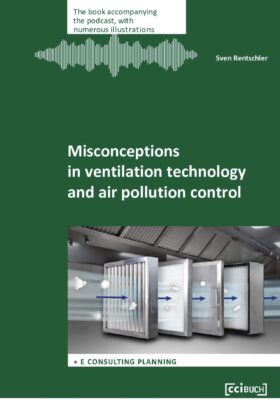
You can find more information and the complete e-Book by clicking on the following link:
Listen to the podcast
You can listen to the current episode directly here:
Why do so many misunderstandings arise in ventilation technology?
Air is invisible.
And that is precisely what makes it so difficult to grasp.
We can’t see how it moves.
We can’t see how pollutants are distributed.
And we can’t see whether an extraction system is really working.
This gives rise to many assumptions that sound logical but are not physically correct.
The typical misconceptions from the ventilation technology book & podcast at a glance
1. “A strong suction is sufficient”
A typical misunderstanding in ventilation technology concerns extraction.
Many people assume that high performance automatically delivers good results.
But something else is crucial:
👉 The correct recording of pollutants
If suction is too far away, it quickly loses its effect – no matter how powerful it is.
2. “Filters solve every problem”
Filters are important.
But they are not the only solution.
In addition to filtering, there are also other methods, such as separation by flow effects.
Which method makes sense always depends on the application.
3. “Clean air is invisible – therefore unproblematic”
A big mistake.
This is because many pollutants are not even visible.
For example:
- Vapors
- gaseous substances
- Vaporized oils
Even if the air “looks clean”, it can be polluted.
4. “UV-C solves the problem”
UV technology is often presented as a panacea.
In practice, however, their effect is heavily dependent on factors such as:
- Application time
- Flow velocity
- Intensity
dependent.
This is why UV-C is usually only used as a supplement.
5. “Air moves easily and predictably”
Many illustrations show air currents as simple arrows.
In reality, they are:
- complex
- turbulent
- depends on many factors
For example, temperature, room geometry or movements in the room.
6. “You can already tell if the air is clean”
Unfortunately not.
That is why measurement technology plays a decisive role.
Only by measuring air quality can it really be assessed and improved.
From podcast to ventilation technology book and back again
One exciting aspect of this project is its development:
A podcast series was first turned into a specialist book.
And now this book has been turned back into a podcast episode with the help of AI.
This creates new access to technical knowledge.
Complex content becomes easier to understand.
And at the same time the technical depth is retained.
Such correlations are often underestimated, especially in ventilation technology.
Conclusion on the misunderstandings in ventilation technology
Air is one of our most important “foods”.
And yet we often pay too little attention to it.
This is precisely why it is worth questioning typical misunderstandings.
Because only those who understand the physical relationships can develop solutions that really work.
Download the ePaper on the X-CYCLONE aerosol separators discussed in the podcast here:
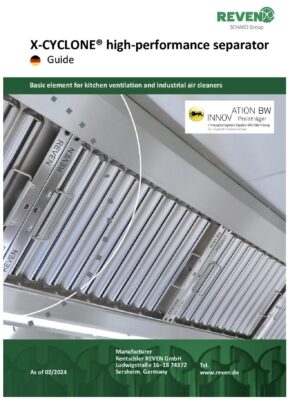
You can find more information and the complete ePaper by clicking on the following link: