









Inhaltsverzeichnis
- The simultaneity factor Phi
- The challenge of simultaneity
- Influence of the simultaneity factor on kitchen ventilation
- Challenges in long-term planning
- Standards and different formulas
- Confusion and consequences for practice
- Calculating the exhaust air via online app – without any tricks!
- Environmental impact and operating costs
- The solution: Digital control of kitchen ventilation
- Efficient ventilation control for the future instead of trickery when calculating exhaust air in kitchens
- Conclusion and outlook
- A future with digital kitchen ventilation
- Vita of Sven Rentschler
- Follow us on social media
The trickery of calculating exhaust air in commercial kitchens, a new comprehensive guide.
Various kitchen appliances are essential in commercial kitchens and it is precisely these appliances that are largely responsible for determining the exhaust air and supply air volumes. Large boiling pans, ovens, tilting frying pans – they all play a decisive role in the design of ventilation systems. But how are the air loads of these cooking appliances defined and displayed? This article delves deep into the world of ventilation calculation to uncover the tricks and pitfalls of determining exhaust air in commercial kitchens.
The simultaneity factor Phi
The simultaneity factor 𝝋 (Phi) is the starting point of this problem and marks the beginning of an often opaque arithmetic and tactics. This simultaneity factor is not only played with, but also gambled with, and it is not uncommon for considerable mistakes to be made. These mistakes can lead to non-functioning kitchen ventilation systems.
The simultaneity factor also plays a decisive role in the needs-based planning of kitchens, as it reflects the capacity utilization of the kitchen. But how do you determine this factor? This is often the problem, as it is difficult to predict how the appliances will actually be utilized. Although there are reference values and tables in the standards, these often prove to be of little use in practice.
The challenge of simultaneity
Let’s first look at two extremes to illustrate the problem. In one case, we see a busy kitchen with many boiling pans in operation. In the other case, only a single appliance is in operation. In one case, this leads to a simultaneity factor of 1 one . The other time to a factor far below 1 one. In practice, however, a uniform factor is simply defined for both of the cases mentioned. This then always determines the maximum amount of air available.

Determining the simultaneity factor over the daily usage time is therefore crucial, as it has a considerable influence on the required supply and exhaust air volume. This is often tantamount to squaring a circle, as all extreme cases of cooking utilization must be covered during the entire time of use. This can very quickly lead to the kitchen ventilation system having far too little exhaust air at peak cooking times when many cooking appliances are working at maximum capacity. During off-peak cooking times, there is often far too much exhaust air.
Influence of the simultaneity factor on kitchen ventilation
The question of whether the kitchen ventilation works and whether pollutants are completely captured and removed also depends heavily on this factor. A high simultaneity factor leads to a higher exhaust air volume and a larger ventilation unit. But how can this factor be determined precisely? This proves to be extremely difficult in planning practice, as neither the ventilation planner nor the system manufacturer can predict with certainty how the cooking appliances will be utilized in the future.
Challenges in long-term planning
Even if the utilization of the kitchen appliances is determined by an experienced kitchen planner, it is difficult to estimate how the usage will actually be in practice and how it will change over the years. This is particularly problematic as many kitchen projects have long lead times and actual usage can change considerably over time.
Even in view of my extensive experience, I consider it extremely unlikely that the simultaneity factor, which is of decisive importance for ventilation technology, can be determined in advance with absolute reliability by planners and system builders.
I am not alone in this view; numerous experts in our industry share this opinion and discuss similar topics. As an example, I would like to mention the book “Silicon Germany: Wie wir die digitale Transformation schaffen” by Christoph Keese, published by Albert Knaus Verlag in 2016. In this book, Christoph Keese has written extensively about digitalization and on pages 58 to 59 he discusses major construction projects in Germany. He talks about the interesting fact that building developers do not plan buildings; they are only responsible for their development. The actual planning and implementation is the responsibility of the planners and construction companies. The operators, on the other hand, limit themselves to renting out the finished buildings without using them themselves.
I derive my thesis from this: Given the findings and challenges we have already discussed regarding the simultaneity factor, the precise determination of this factor appears to be almost impossible. It is a complex problem that cannot be solved by technical calculations alone, but requires a comprehensive approach.
Standards and different formulas
The situation becomes even more complex when you consider that different formulas can be used to calculate the exhaust air and supply air volumes of commercial kitchens. In Germany, both VDI 2052 and DIN EN 16282 exist, with slightly different mathematical approaches.

In VDI 2052, the termic air flow is simply multiplied by the simultaneity factor. In DIN EN 16282, on the other hand, the third root is taken from the simultaneity factor before multiplying.
Confusion and consequences for practice
This leads to different results and confusion among planners and system builders. This controversy over the determination of the simultaneity factor very often leads to many kitchen ventilation systems being incorrectly dimensioned. On the one hand, the air volumes are too high in practice when the cooking appliances are under-utilized, which leads to a waste of energy. On the other hand, the air volumes are far too low when all cooking appliances are used very intensively at the same time. This leads to excessive air pollution in the kitchen and unacceptable working conditions for the staff.
Calculating the exhaust air via online app – without any tricks!
Calculate the real and correct exhaust air with our online app. A web-based software that requires no installation at all! Click here for the RECOMAX online app – Visit our new RECOMAX online app by clicking on the button below
Environmental impact and operating costs
This has an impact on the environmental balance and operating costs. Another problem is the distribution of air flows in the kitchen. In most cases, the exhaust air is distributed evenly across the entire collection system, regardless of the actual activity of the appliances.

The solution: Digital control of kitchen ventilation
This means that pure, clean air is extracted in areas where there is no cooking activity. Not only is this inefficient, but it can also lead to significant pollution in areas where cooking is actually taking place and much more exhaust air is needed. An intelligent solution to this problem is to digitize the kitchen ventilation and control it according to demand. This can be achieved by dividing the kitchen into different zones and using sensors to detect temperature and humidity signals.
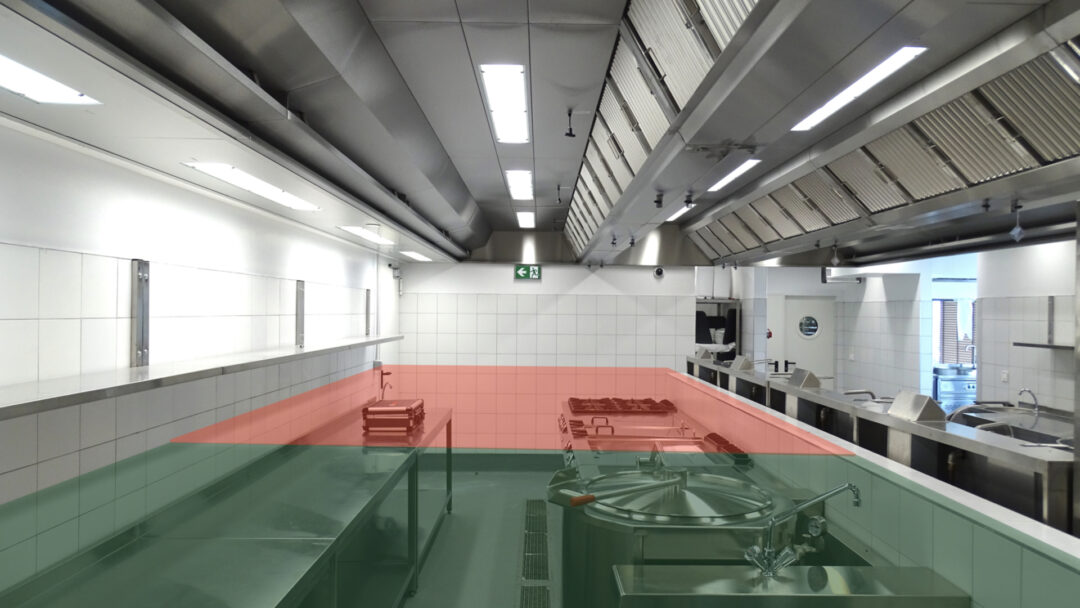
Efficient ventilation control for the future instead of trickery when calculating exhaust air in kitchens
These signals make it possible to detect the activity in the individual zones and control the exhaust air accordingly. This intelligent control allows the exhaust air to be directed specifically to areas with cooking activity, while in quiet areas the extraction is reduced or switched off. This results in more efficient and energy-efficient kitchen ventilation, which has less impact on the environment and reduces operating costs.
Conclusion and outlook
Although the calculation of the simultaneity factor remains a complex issue, the effects of this calculation can be minimized through the digitalization and demand-based control of kitchen ventilation. This enables efficient and environmentally friendly ventilation in commercial kitchens that meets both operator requirements and environmental protection goals.
A future with digital kitchen ventilation
Overall, it is clear that the trickery involved in calculating exhaust air in kitchens can be overcome with intelligent technologies and needs-based control to enable more efficient and environmentally friendly solutions in ventilation technology. It is time to say goodbye to outdated calculation methods and shape the future of kitchen ventilation digitally.
Sven Rentschler – REVEN GmbH
Contact Sven Rentschler: reven.link/sr
Vita of Sven Rentschler
Sven Rentschler is the head of Rentschler Reven GmbH. This company, part of the SCHAKO Group, specializes in air purification systems. He strives to raise awareness of air purification and ventilation technology worldwide.
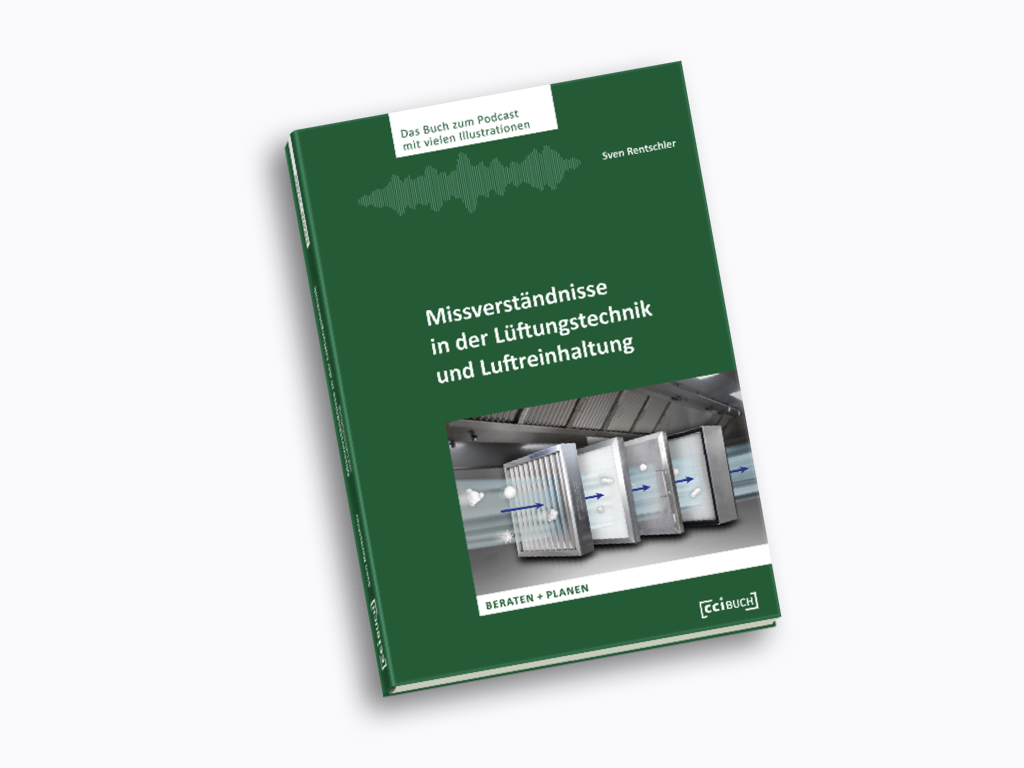
In 2023, he published a book entitled “Misunderstandings in ventilation technology and air pollution control”.
During his studies at the Fraunhofer Institute, Rentschler gained experience in technology and innovation management. This time awakened his passion for innovation, marketing and design.
In 1995, he joined the family business and transformed it into a modern industrial company in two decades, doubling turnover with the same number of employees.
Rentschler Reven became known for its technology. Through his commitment, he secured two international patents in 2010 and 2014. In addition, his company received the Baden-Württemberg Innovation Award for the X-CYCLONE® technology in 2013.