










The doubts remain! New research report on the effectiveness of ozone and UVC in kitchen ventilation.
In the recent past, there have been passionate discussions about the effectiveness of ozone and UVC in kitchen ventilation. What was the core issue? Why is the topic being discussed so intensively and so passionately? What new studies and findings are there? Sven Rentschler comments on all this in an interview:
(Click on this link to go directly to the new study results: Results of the new US studies)
Sven, please explain to the readers why such systems are used in kitchen ventilation? We will then discuss the effectiveness of ozone and UVC in kitchen ventilation.
Basically, the discussions start with this question! There is no uniform opinion even on this in our industry. Many of our competitors use ozone and UVC in kitchen ventilation systems with the aim of eliminating odors. However, there are a number of competitors who also use such systems to remove grease and oil from kitchen exhaust air.
Removing odors and removing grease and oil from the exhaust air, isn’t that the same thing?
No, it is not! Let me explain it in simple terms. If we focus on the task of odor elimination, then we are talking about airborne vapors. In other words, something that can be observed when refueling a car, for example. When refueling a car, we are not dealing with aerosols, particles or droplets! All liquid flows logically from the pump directly into the vehicle’s tank. Nevertheless, we can smell the fuel. What we smell is vaporized fuel. There is something very similar in kitchen exhaust air. Evaporated fats and oils, which can sometimes cause considerable odor nuisance in the exhaust air from kitchens.
Okay, I understood about the odors, but what about the removal of oils?
Well, as described above with the odors, the removal of aerosols, particles or droplets is something completely different. These are substances in a different aggregate state! This is more comparable to what can be observed in a paint shop or a waterfall, for example. Aerosol particles ranging in size from around 0.001 to over 100 micrometers, carried by air currents. This can also be observed in a cooking process, for example above a frying pan. There you will find airborne particles of oil, i.e. aerosols of oil.

Understood, i.e. ozone and UVC in the kitchen ventilation should remove both the vapors and the aerosols from the exhaust air?
Yes, at least that is the promise of many manufacturers.
With one and the same ozone and UVC system?
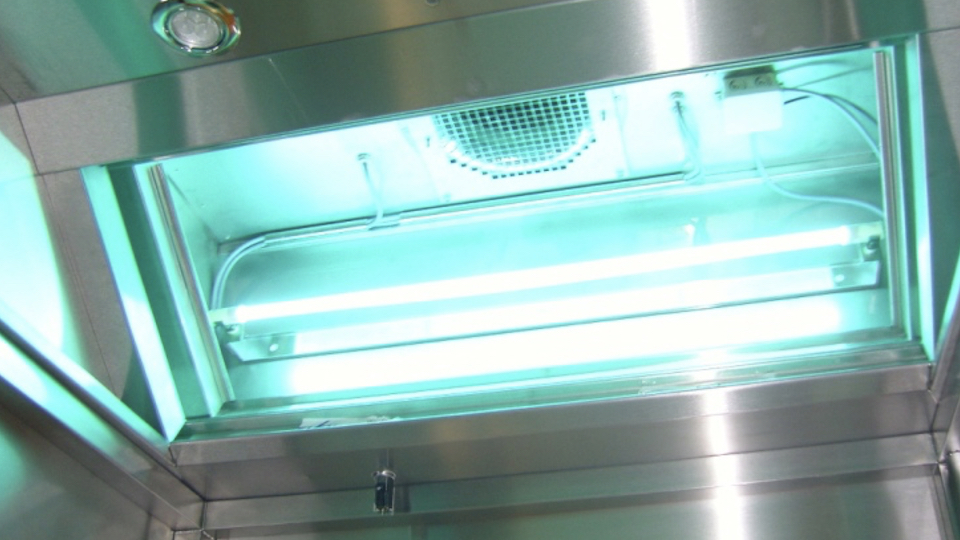
Yes, there are manufacturers who claim that! I’ll take the liberty of quoting the statement of a market companion on this one to one! “Odor- and grease-contaminated exhaust air is extracted and passed over special UV lamps. This results in photolysis, in which organic substances contained in the exhaust air, such as grease, are destroyed. The grease load and odor emissions are reduced by up to 95%. The end products are oxygen, carbon dioxide, water and dust-like, 100% biodegradable residues, which are blown out through the exhaust air system.” So according to this description, the chemical bonding of the fats is supposed to be broken down? Triggered by UV radiation, which is simply complete humbug and has been refuted by several studies!
Does this mean that ozone and UVC are ineffective in kitchen ventilation?
I don’t want to go that far, but it is very clear that there are big differences. There is a big difference between wanting to eliminate odors and wanting to reduce aerosols. Simply wanting to do everything quickly with a UVC system is just nonsense and simply does not do justice to the task at hand.
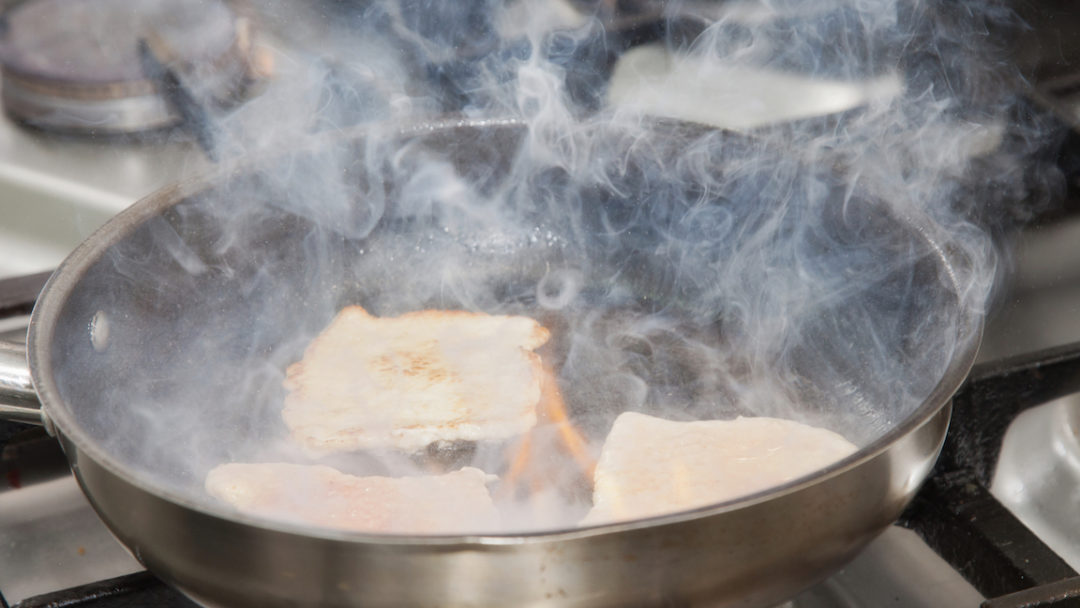
The following illustration shows aerosol particles far smaller than one micrometer. Vaporized oil can also be seen. So now we simply switch on a UVC tube in our exhaust hood and it is supposed to convert this into oxygen, carbon dioxide, water and white dust within a fraction of a second? Seriously?
But something like that would have to be questioned by your market companions, wouldn’t it?
No, it won’t. Our industry has made itself quite comfortable! They are not behaving much differently to how the German automotive industry has behaved in the USA in the past.
What do you mean by that?
Well, at least for me, many statements on this form a similar picture to what you can read about the diesel scandal. Without much effort, without major studies, in some cases even without the use of any measurement technology, some manufacturers are formulating results, functions and properties. These are neither comprehensible, nor are they part of a study, or at least part of a somewhat more elaborate series of measurements.
Are you sure? Is that really the case?
Yes, interested parties can read about this on the homepage of cci Dialog GmbH, for example, in their article “Controversy about UVC”. There you can read, for example, statements such as that years of use of ozone and UVC in kitchen ventilation must be proof of effectiveness! Or you can read that the effectiveness has been observed! It is also noted that the effectiveness of the technology has apparently been proven several times by scientific studies. You can read about it in detail here: https://cci-dialog.de/138-2/
Have you been able to look at these scientific papers and understand the results?
Oh where from, these manufacturers who refer to such scientific studies do not even publish them. These studies were not even published in the course of this controversial discussion. They simply claim that there is something that has proven its effectiveness. Or it is claimed that the effectiveness has been observed for years and that there can be no mistake about this.
Is that really all?
Yes, we are always on the lookout for new input. Even controversial content. But as noted, third parties never oppose anything, only criticize and question it. We are always very active and constantly try to educate ourselves and learn. For example, in the cci Dialog GmbH article “Controversy about UVC”, a US study on the effectiveness of ozone and UVC in kitchen ventilation was literally torn to shreds by many manufacturers.
Why? What was the result of this study?
The results of this study basically confirmed our doubts and concerns. Among other things, the following was noted:
“…Samples of the liquid phase and the vapor phase were analyzed using gas chromatography-mass spectrometry coupling. The test showed a mass change of less than 0.001 %. These gravimetric results alone suggest that there is no significant decomposition of volatile substances due to the effects of UV light and ozone.”
The study also came to the following conclusion:
“…the insignificant drop in ozone concentration in Table 5 shows that only about 35% of the ozone is consumed, even if sufficient fine particles in fat-containing aerosols are available for a reaction. This strongly suggests that a large proportion of the ozone does not fulfill the fat-reducing function attributed to it, even with the smallest particles, but is released into the atmosphere, where it contributes to air pollution…”
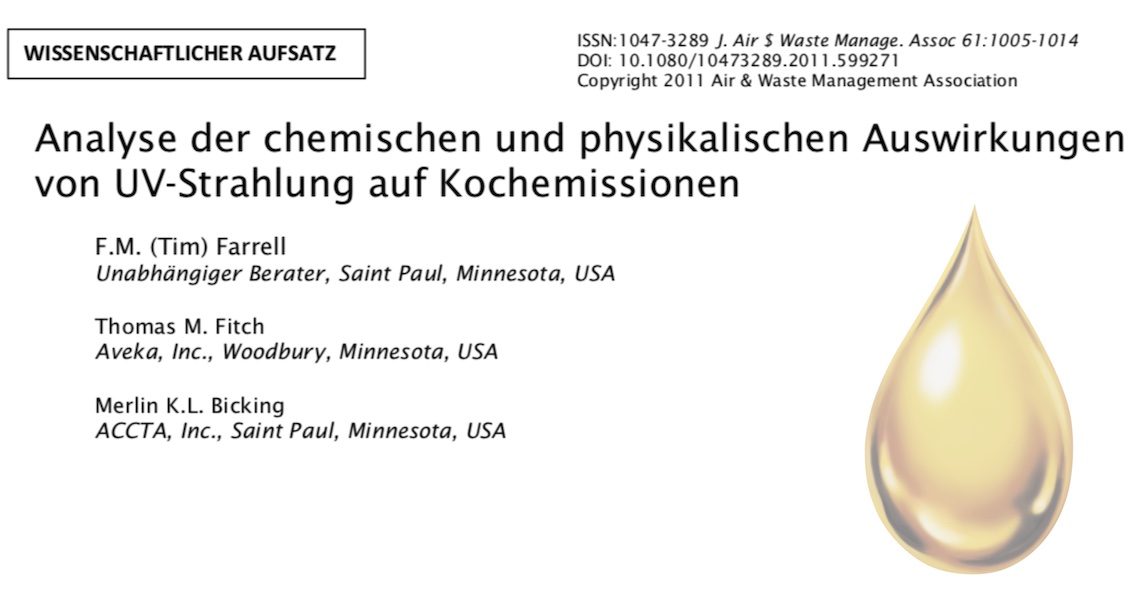
In the course of this discussion, we also took the trouble to translate the US study into German. We then made this available to all those involved:
What was the outcome of this discussion?
The market companions made it quite easy for themselves and responded to this study with quite simple statements. The study was said to be outdated several times. Or the test set-ups were not practical. There are now more modern systems for the use of ozone and UVC in kitchen ventilation. These would lead to completely different results.
Have supplementary studies and reports been published on these statements?
No, as previously noted, there were a number of market participants in this discussion who referred to scientific studies. They have not published one supplementary study in the context of this discussion!
But once again, Sven, why are you comparing all this with the diesel scandal?
Because a lot of the discussions about the effectiveness of ozone and UVC in kitchen ventilation give me the impression that many people want to take a shortcut. They don’t want to miss out on lucrative business, so they simply try to take the business with them without much effort. However, the fact that this can have considerable disadvantages and risks for the user is ignored. Often ignored due to a lack of knowledge.
What do you mean?
How is an industry supposed to be enlightened if discussions and arguments are held at the level outlined above? Arguments are often exchanged without any scientific basis. For example, fictitious studies are cited that will never be published. Many manufacturers do not even have the right measurement technology to at least validate the function of their own systems on a project-related basis. This can then become a great danger for the user, for example when using ozone in the exhaust air.
Why can ozone in kitchen exhaust air be dangerous for the user?
Because ozone can be very dangerous for your health! In many countries, the limit value for indoor ozone is set at a maximum of 2mg ozone per cubic meter of indoor air! In other words, an ozone limit value of 2mg/m³. This was also the previous ozone limit value in Germany, but it has been abolished. The DFG played a leading role in the abolition of the previous ozone limit value in Germany.
☞ According to the classification criteria for carcinogenic substances of the German Research Foundation (DFG), ozone is classified as category IIIB. This means “classified as insufficiently investigated, but with cause for concern”.
Okay, I understand, but that’s a limit value for indoor spaces. The kitchen ventilation blows the air outside into the environment, right?
Yes, of course that’s right! If the kitchen ventilation system is correctly dimensioned and constructed, then everything can be solved. So that all the ozone is broken down again by the time the kitchen exhaust air leaves the building envelope. But you should be sure of this! Given the level of knowledge that sometimes prevails in our industry, I have strong doubts as to whether such ozone systems are always correctly dimensioned. You should also bear in mind that kitchen exhaust air is often blown out into passages and other areas with high public traffic!
People in such areas would then be fully exposed to the ozone, should it not yet be 100% degraded?
Exactly, they would breathe in undegraded ozone! You have to imagine that recognized experts, as well as standards, specify an ozone limit value in the air of 20 mg/m³. Valid for kitchen exhaust air in outdoor areas! Let’s compare this 20 mg/m³ (20,000 µg/m³) ozone value with what is noted on the homepage of the German Federal Environment Agency on ozone:
“In order to rule out health risks to the population in the event of short-term exposure to elevated ozone concentrations, the 39th BImSchV sets information and alert thresholds. The information threshold of 180 micrograms per cubic meter (µg/m³), averaged over one hour, serves to protect the health of particularly sensitive population groups. The alert threshold of 240 µg/m³, averaged over one hour, indicates the threshold above which there is a risk to the health of the population as a whole. The German Medical Journal also states the following: “An EU directive stipulates 180 µg/m³ (1-hour value) as the information threshold and 240 µg/m³ as the warning threshold for the population. Changes in lung function parameters already occur at values between 160 µg/m³ and 240 µg/m³.”
☞ Please note that the units of the last limit and threshold values listed are units in micrograms per cubic meter (µg/m³)! This means that the value of 20 mg/m³ quoted above by the kitchen ventilation expert would be a value of 20,000 µg/m³ in this unit of measurement!!!!

Seriously? That doesn’t exist?
But seriously. These are simply facts that need to be taken into account. Facts about which information must be provided! And which every user of ozone and UVC in kitchen ventilation must be informed about. These facts about the limit values simply have to be taken into account when using UVC systems and ozone generators. Metrological proof must also be provided that these thresholds are not exceeded.
If we don’t do all this and oversimplify the issue, it simply becomes dubious. Not only that, but it is also extremely dangerous, as the example of ozone has now shown.
What are the latest findings on this? At the beginning of our interview we noted that there are new study results, can you explain this at the end?
The ASHRAE (American Society of Heating, Refrigerating and Air-Conditioning Engineers) conducted a research project entitled “Research Project 1614 Determining the Effectiveness of UVC Systems on Commercial Cooking Effluent”. The ASHRAE Journal Newsletter reported on this recently completed research project and its results.
What are the experts reporting from the USA, what are the latest results and findings?
Basically, the results of the older US study I mentioned earlier were confirmed and repeated. It is critically noted that there is virtually no sound measurement technology used in practice. Furthermore, it is criticized that the effectiveness of ozone and UVC in kitchen ventilation for grease and oil degradation could not be scientifically validated. You can read the original here: https://www.ashrae.org/news/ashraejournal/ashrae-research-project-1614-determining-the-effectiveness-of-uvc-systems-on-commercial-cooking-effluent
You can also buy the documentation on the new research project from 2020 as a PDF here https://www.tandfonline.com/doi/abs/10.1080/23744731.2020.1763144
Have you read this new research report?
Yes, we have. At the end of this new research report on the effectiveness of ozone and UVC in kitchen ventilation, the summary and conclusion is as follows:
“This project aims to develop a test method to evaluate UVC efficacy. Emissions from two representative cooking appliances were measured from a UVC hood in a model kitchen and used. This was done to evaluate the performance of the UVC system in terms of grease deposition and particle concentration. The presence of the UVC lamp had limited effects on reducing grease deposition and particle concentrations.
This is probably due to the fact that the reaction conditions in the UVC hood are essentially insufficient to drive organic reactions to completion. The change in the solubility of the fat deposit in water induced by UVC is insignificant. And the flammability of the fat deposit is not always reduced. In 3 of the 5 cases, a reduction in flammability by UVC was observed, but only in one of the cases was a reduction of more than 10% achieved. In summary, the data show that although the UVC lamp initiated the oxidation and decomposition of the cooking emissions, the reaction cannot be fully completed within the limited dwell time.
The potential for decomposition of the emissions by the UVC was not confirmed by the tests carried out alone.”
This basically confirms what you have said and indicated!
Yes, it does! But it is likely that our market companions will again dismiss the ASHRAE’s research results as unsubstantiated and incorrect. Just as I experienced in the previous discussion. Once again, unobjective counter-arguments will be made out of thin air. Which, as usual, will not be backed up with any real sustainable findings. The current global pandemic confirms this.
Where are the parallels in the current pandemic?
The results of the ASHRAE research study highlight a very important point:
☞ The exposure time
This refers to the time that UVC radiation and ozone gas have to act on the oil aerosols. It is important to know that the air speed in commercial kitchen hoods is around 2 meters per second. This means that when an oil particle in the air is extracted from a kitchen hood, it travels through the air at around 2 meters per second. It then flies past the UVC tube in the kitchen hood or in the exhaust air duct at the same speed.
Oil aerosols in the kitchen ventilation move at 2 meters per second?
Yes, the aerosol in kitchen ventilation systems moves at about this speed. The aerosol is often exposed to UVC radiation for less than a second! In the current pandemic, it has already been established that such a short exposure time is nowhere near enough to kill viruses! The ASHRAE research report has now come to a similar conclusion. That such short exposure times hardly lead to any significant degradation of the oil aerosols!
What is your summary and conclusion to all these discussions?
That there is still an incredible amount to learn from all of us. There is still a great deal to investigate and research. All of us in the industry need to take a much more differentiated and sustainable view of the whole thing. Holger Reul recently discussed this very well with me in an online conference. Here is a short YouTube excerpt from this discussion:
That’s why you should be careful! Be careful with all the effects that are attributed to UVC and ozone. Just because UVC radiation can kill bacteria and viruses after a long exposure time does not necessarily mean that it can break down oil aerosols! On the contrary, all the studies we have been able to inspect to date have come to exactly the opposite conclusion! Namely that ozone and UVC in kitchen ventilation are hardly effective against oil aerosols!