










How and why does oil mist form in a machine tool? In modern workshops, everything is running at full speed. Machine tools mill, turn and cut – often around the clock. This creates something that many people underestimate: Oil mist. In this article, we show how oil mist is created in a machine tool, why this is a problem – and what you should definitely look out for.
What is oil mist?
Oil mist consists of tiny droplets of coolants and lubricants that are released into the air. These substances are used when machining metal or other materials. They cool the workpiece and ensure that the tool does not break.
However, the liquid turns into a mist – sometimes even vapor or gas. And this is exactly what can become a problem.
Why does oil mist form in the machine tool?
There are several reasons why oil mist is produced in the machine tool:
High speeds:
The spindle of a machine tool often rotates at many thousands of revolutions per minute. When the coolant or lubricant hits this rapidly rotating spindle, it is broken up into tiny droplets – the oil mist is there.
High pressure:
Modern machines spray the coolant onto the workpiece at up to 80 bar. The high pressure ensures that the liquid is finely atomized – similar to a high-pressure cleaner.
Heat and evaporation:
Where there is a lot of friction, there is also a lot of heat. If the liquid is heated too much, it evaporates. This produces not only mist, but also invisible vapor or gas. This phase is particularly difficult to detect and measure.
Why do we often measure the wrong thing?
Many only measure the aerosols – i.e. the visible droplets in the air. The problem is that modern machines often produce many more vaporized substances. They are invisible, but still in the air and therefore a real danger!
A simple particle measuring device then often shows: “All good”. However, the air is heavily polluted – just with gases that you can’t see.
How can you recognize this?
There are special measuring devices, such as the so-called FID device (flame ionization detection). This can also be used to measure vaporized hydrocarbons – i.e. invisible pollution.
In our expert talk on YouTube, we show what such measurements look like. We also talk about how to really understand and assess air pollution.
Expert talk also online as a podcast:
What helps against oil mist in the machine tool?
The good news is that there are solutions. But they have to fit the application:
Condensation:
First, the steam must be turned back into droplets. This happens with a so-called condenser, for example with our REVEN Pipe. The vapor is made liquid again by temperature differences. You can find a detailed explanation of the REVEN Pipe in a separate blog article:
Agglomeration:
In the next step, many small droplets are combined to form larger ones. These larger droplets can then be taken out of the air more easily.
Separation:
Now you can switch off the droplets with an air purifier. The larger they are, the better it works.
Why simple solutions are often not enough
There is no such thing as an appliance that can “do everything”! You have to take a close look at the machine:
How fast does it rotate? How much pressure is used? Is steam generated? What substances are involved?
That’s why we work with checklists. This is the only way to find out whether you can use a simple appliance or whether you need additional modules – for condensation, for example. You can download the checklist here:
What does this mean for the machine operator?
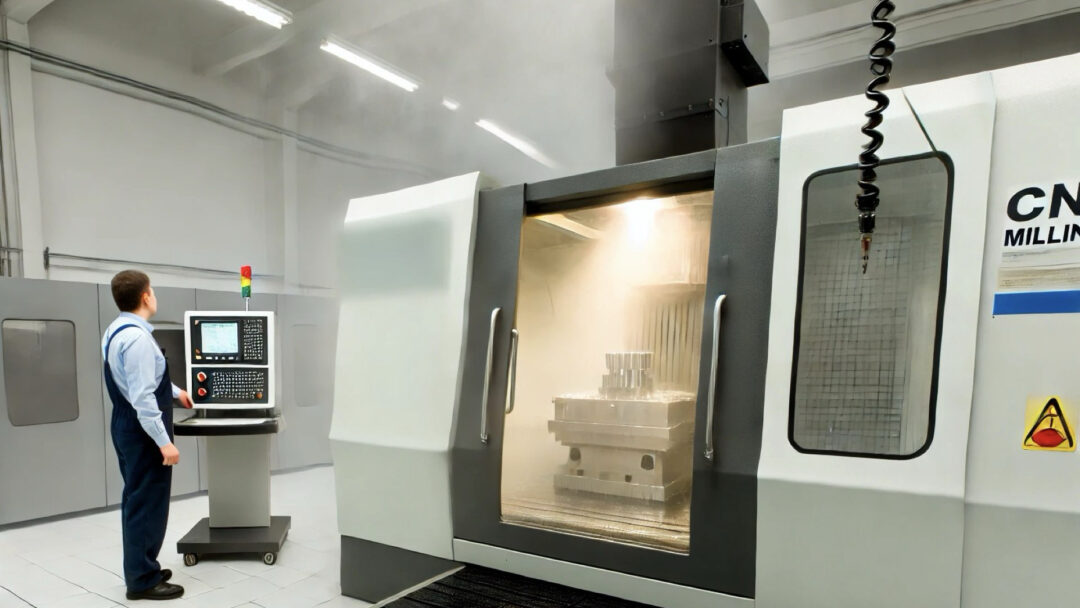
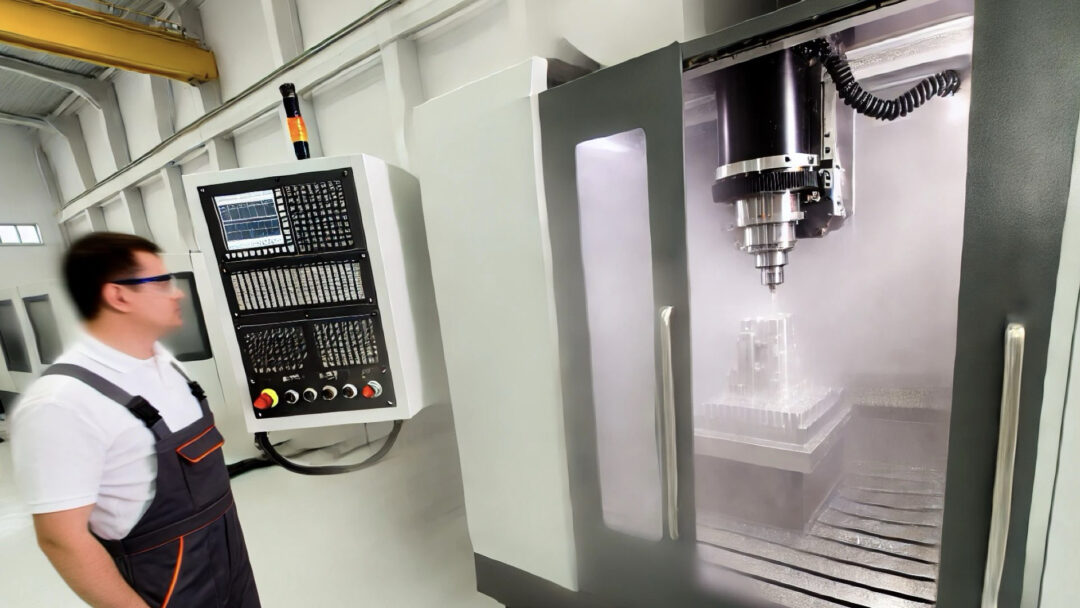
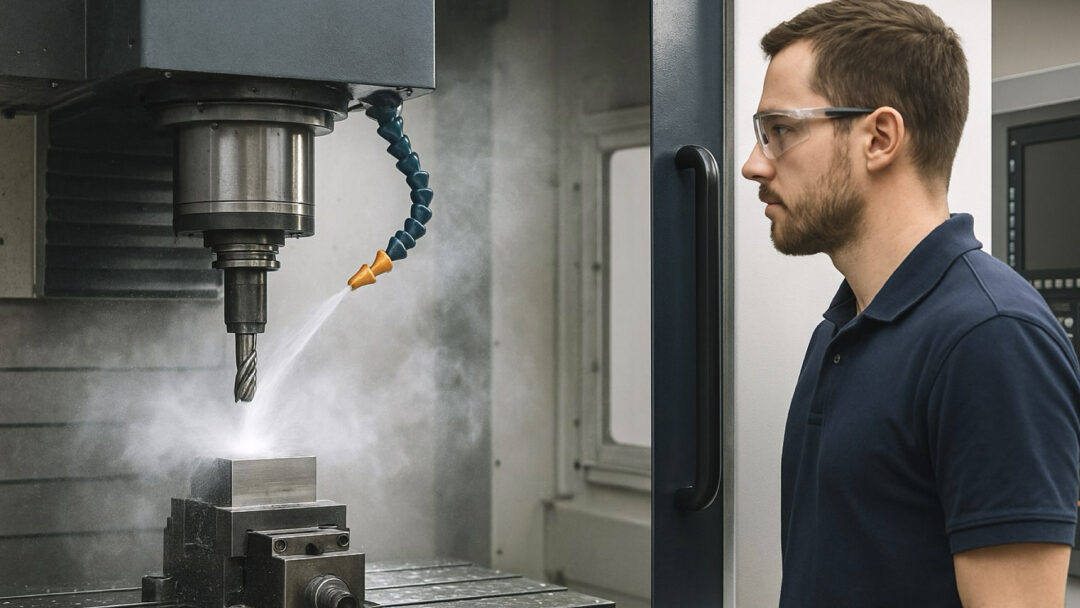
Quite simply: safety! When the cabin is opened, no oil mist must escape into the workshop. Modern systems detect when the door opens and automatically adjust the extraction system. This keeps the air clean – and the operator healthy. The following pictures show this very well: despite the service door being open, the oil mist from the machine tool remains in the cabin and therefore does not pollute the environment!
Conclusion: Oil mist machine tools – an often underestimated risk
Oil mist in the machine tool is caused by high speeds, pressure and heat. It is not enough just to measure visible particles. Vaporized substances must also be detected and treated. With the right system – and the right knowledge – the air in the workshop can be kept clean.
👉 We explain more about this in our new YouTube expert talk – with lots of practical examples and solutions. Watch it now!