









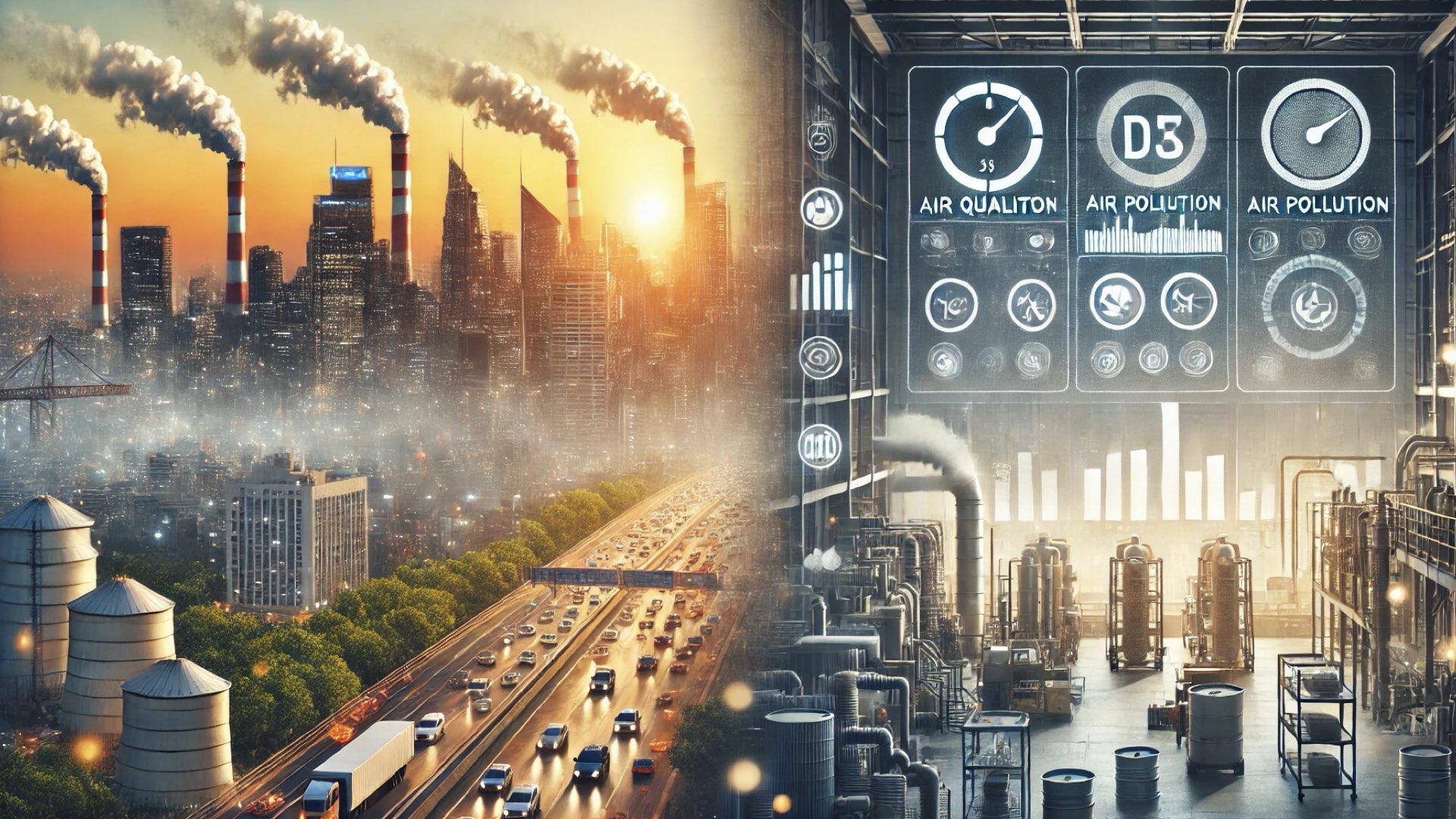
Air quality in large cities vs. production halls: A comparison that raises questions! Air quality affects us all. Driving bans are being discussed in German cities when particulate matter levels rise. But many people overlook this: The air quality in production halls is often much worse than outside in large cities. Many people mistakenly believe that the air indoors is better per se. Our latest video shows how wrong this assumption often is and why the issue of “air quality” also deserves top priority indoors.
Poor air quality in large cities: a problem with solutions
Air pollution in large cities is omnipresent. Authorities measure particulate matter levels and intervene if pollution exceeds certain limits. The first warnings are issued when particulate matter levels reach 50 µg PM10 per cubic meter of air. However, compared to the pollution in production halls, these values seem almost low. City dwellers often notice the bad air, especially when smog becomes visible. This clear perception is lacking in many production halls – here the air quality often goes unnoticed and unchecked.
The invisible danger indoors
In contrast to urban air pollution, poor air quality in production halls often remains invisible. Machines and processes generate a high level of particulate pollution that is difficult to detect without measurements. Studies by REVEN show that values of up to 500,000 µg per cubic meter are reached in some halls. That is ten thousand times the urban limit values! Many employees breathe in this highly polluted air every day – a health risk that requires urgent attention.
Why we need to rethink indoor air quality
The assumption that indoor air is clean often leads to fatal misjudgements. Air quality has a direct impact on our health – high levels of pollutants increase the risk of respiratory diseases and can lead to chronic complaints in the long term. Even the WHO has shown in studies that a reduction in particulate matter levels reduces the mortality rate in cities. These findings can also be applied to indoor spaces: improving the air quality here actively protects the health of employees.
How modern technologies can improve air quality
Targeted improvement of air quality in production halls is possible today. With advanced ventilation systems and special filters, companies can effectively reduce pollution. REVEN offers solutions that ensure a significant improvement in air quality even in heavily polluted rooms. These technologies filter particles that could lead to health problems in the long term and create a much safer working environment.
Find out more in the new video and podcast
What to wait for? In our new video on YouTube, we show how indoor air pollution is often underestimated. You can also find out what measures you can take to improve air quality in the long term.
The video is also available as a podcast and can be listened to on Spotify:
Conclusion
Air quality does not end at the doorstep. In production halls, it is often significantly worse than outside and poses major health risks. With modern technology and a clear understanding of the issue, we can improve air quality in the long term. If you act now, you protect your employees and create a safe, clean working environment.