









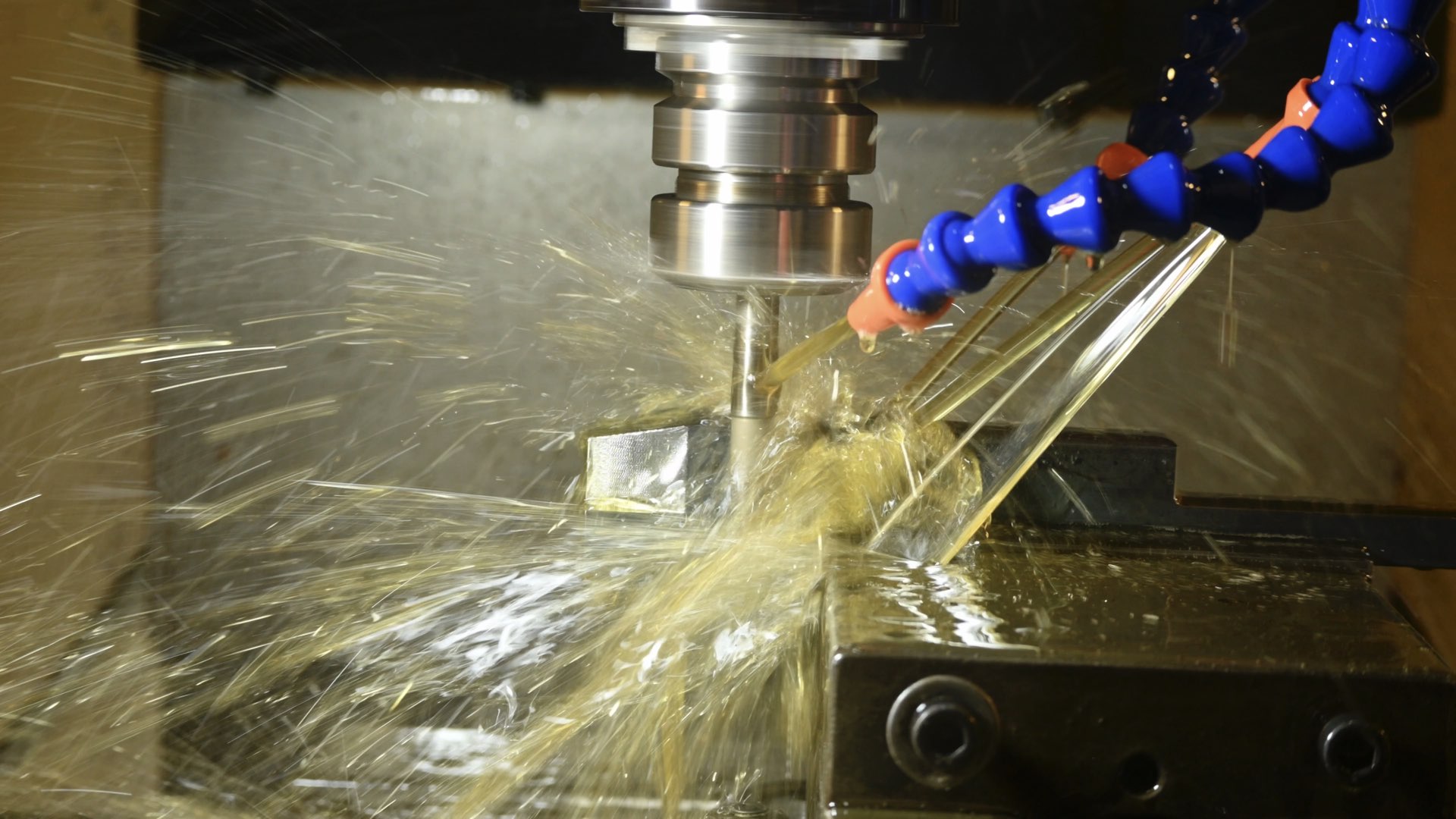
Air pollution control in mechanical engineering: Why the material makes all the difference! Anyone who has to deal with cooling lubricants, oil mist or dust in mechanical engineering knows the problem: clean air is not a given. Proper air pollution control in mechanical engineering depends heavily on the material being processed. And this is exactly what our experts discussed in an exciting talk.
Different materials – different challenges
Not every material produces the same emissions during milling or turning. Plastic, for example, is usually processed dry. Hardly any mist or dust is produced here, so the effort required for air purification is low.
The situation is completely different with steel. Normal steels are often machined with emulsions, i.e. with water-soluble cooling lubricants. The higher the quality and “harder” the material, the more likely it is that pure oil will be used. And this oil brings with it new requirements for air pollution control in mechanical engineering.
Gray cast iron? Dry or wet? Important for air pollution control in mechanical engineering!
A good example is gray cast iron. This material is often processed dry, which produces fine dust. To safely extract this, our air cleaners rely on so-called spraying. We use this to rinse off the dust in the device, as this prevents filters from becoming clogged. We use our REVEX® spraying technology for this purpose:
However, if gray cast iron is processed with emulsion, other solutions are required. Combined devices are used here, which can be switched on or off depending on the situation. This makes the technology flexible, which is particularly important for subcontractors.
High-alloy materials? Then it’s electrostatic!
High-alloy metals, such as those used for medical implants or watch cases, are a completely different case. These materials are almost always processed with extremely fine oil. Such processes require special filter technology and are very important for air pollution control in mechanical engineering.
Here we often work with electrostatic filters that remove even the smallest oil droplets from the air. These filters use high voltages to electrically charge and separate the particles. We also use our REVEN pipes upstream of these filters to condense some of the oil in advance.
In practice, it turns out that when the technology is right, the air in production is as clean as in an open-plan office. A good example of this is our customer IWC in Schaffhausen. You can find all the information in our YouTube expert talk:
Also in a slightly longer version with even more information as a podcast online:
Air pollution control in mechanical engineering requires knowledge and planning
When choosing an air purifier, you need to know in advance which material will be processed. This is one of the most important pieces of information of all. This is the only way to find the right system without incurring unnecessary costs and without compromising on air quality.
That’s why we have also developed a practical checklist. You can use it to record all the necessary information directly on the screen, quickly and easily. Here is the link to download the PDF checklist:
Disposable filters? Only in exceptional cases
Another topic that often causes discussion: so-called HEPA filters. These filters are extremely fine, but they are also expensive, heavy and have to be disposed of regularly. They usually make no sense in mechanical engineering, as most particles can be separated beforehand using other techniques: condensation, agglomeration or mechanical separation.
If such a filter is nevertheless used as standard, this is often more of a sales argument than a sensible solution. This is because the customer ends up paying for expensive filter changes without any real added value.
Air pollution control in mechanical engineering is no coincidence
The choice of the right air cleaner depends heavily on the material being processed. Plastic, steel, gray cast iron or high-alloy stainless steels – each material has its own requirements. Knowing these and planning correctly ensures clean air, less downtime and more sustainability in operation.
Air pollution control in mechanical engineering is therefore not an off-the-shelf product. It is the result of experience, knowledge and good advice.