






Inhaltsverzeichnis
Nevertheless, the two terms have been equated in our industry for years.
Volume flows are calculated precisely, hoods are dimensioned correctly and ducts are designed in accordance with standards. That seems to be the end of the matter.
But is it really?
What we showed live in the webinar
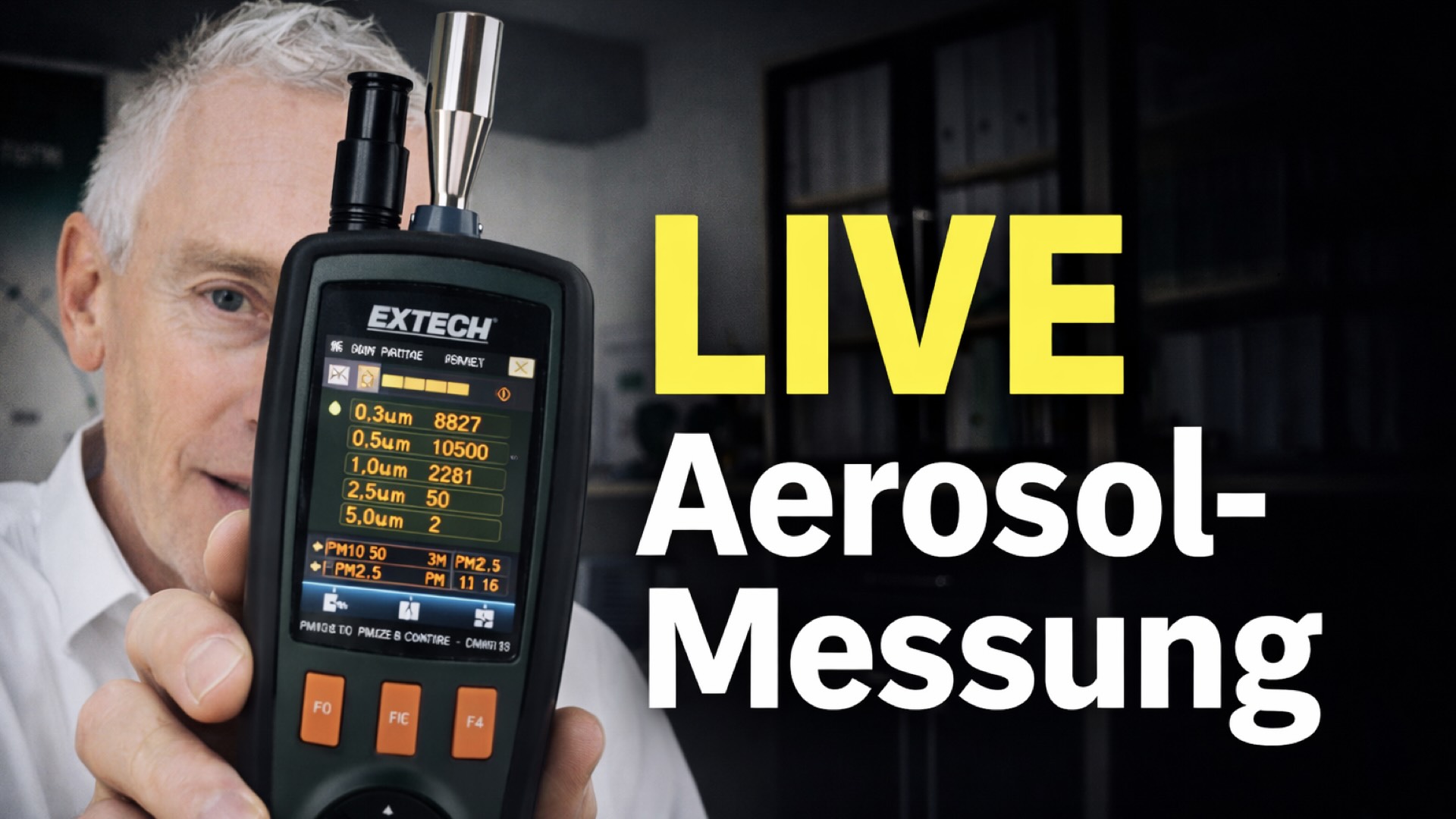
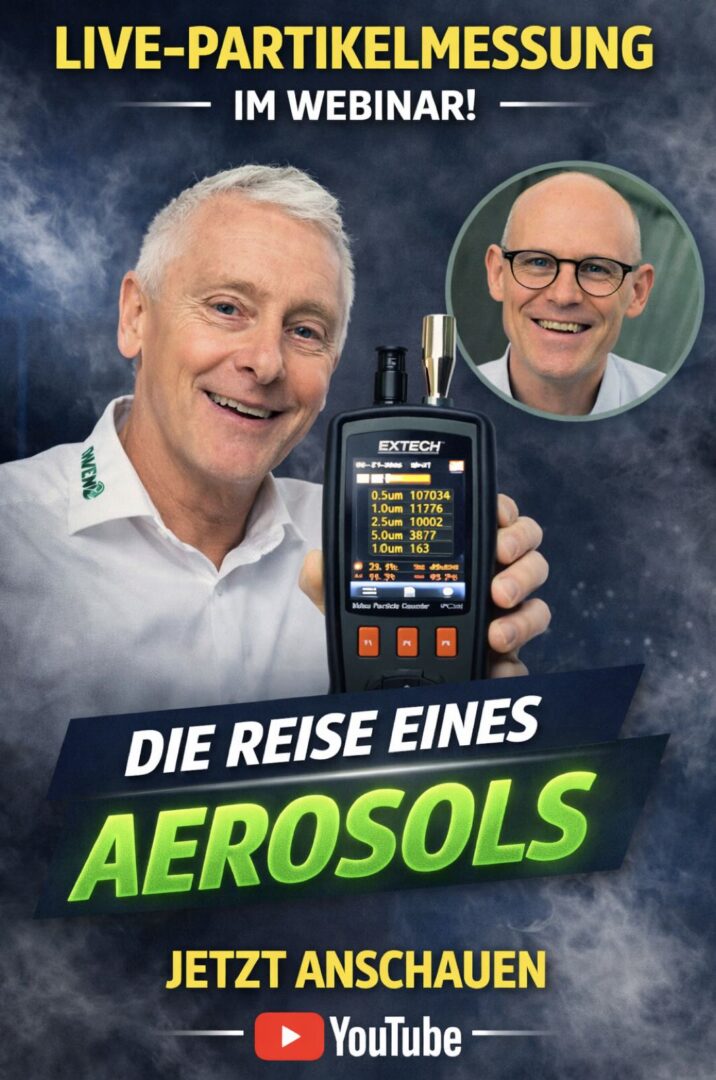
In our live webinar with over 200 participants, we not only talked about aerosols, but also measured them live – during the presentation and with a real particle measuring device.
Why?
Because you can’t talk seriously about air pollution control if you don’t measure it.
The real misunderstanding
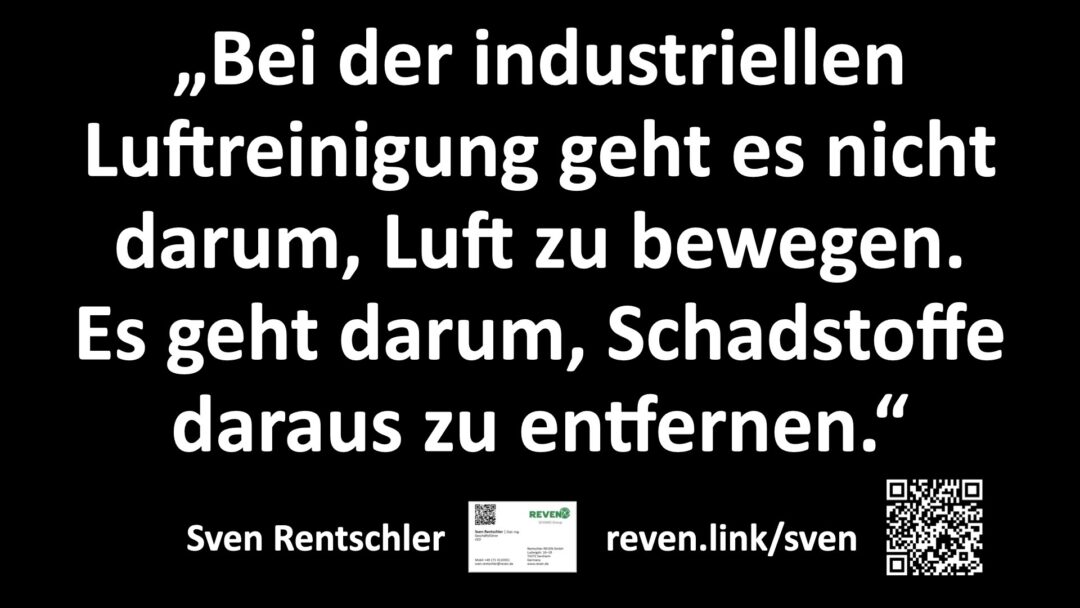
Capture does not mean separation.
Extraction does not mean cleaning.
And moving air does not mean removing pollutants from it.
This is precisely where the core problem lies.
In many projects, volume flows are calculated precisely, but particle sizes and real concentrations remain unknown. As a result, there is often no basis for a real assessment of the situation.
How big are the particles really?
Or how high is the load?
And how much of it is vaporous?
And what can be separated mechanically?
The honest answer is often: we don’t know.
“100 % degree of separation” – under what conditions?
This statement is easy to hear.
However, the question arises: For which particle size does this apply? At what concentration? And under what real operating conditions?
A laboratory value says little if the system sees completely different loads in everyday life.
If you don’t measure, you can claim a lot.
If you measure, you have to explain.
Why particle size is crucial
A PM10 particle is a maximum of 10 micrometers in size, a PM2.5 particle is significantly smaller. A vaporized water molecule, on the other hand, measures around 0.0003 micrometres.
This makes it clear that vaporized molecules cannot be separated mechanically because they behave completely differently to larger particles. No filter or baffle plate can change this.
If vaporized components are present, other strategies are required, such as targeted condensation. Otherwise, the substances will continue to migrate through the duct, appliance and ultimately into the environment.
The live particle measurement
That’s why we showed real measured values in the webinar. No simulation and no assumptions, just concrete figures.
This made visible what would otherwise remain invisible.
And this is exactly what surprised many participants.
The uncomfortable question
How often are particle measurements actually carried out in real projects?
This is a matter of course in cleanrooms.
The same applies to operating theaters.
In contrast, it is surprisingly rare in production processes – even though this is precisely where high levels of contamination occur, for example in commercial kitchens or in mechanical engineering.
Measurement is the basis of any serious planning.
Why we consciously address the topic
We don’t want to provoke, we want to educate.
Air pollution control does not begin in the duct, but in understanding the particles. Furthermore, it does not end with extraction, but with the actual separation of pollutants from the air flow.
The complete webinar recording
We explain step by step in the video:
- what aerosols really are
- Why the aerodynamic diameter is crucial
- Which separation mechanisms work
- where mechanical systems reach their limits
- and why measurement technology is indispensable
🎥 Click here for the recording on YouTube:
Conclusion
Ventilation is important because it captures and transports air. However,
air pollution control goes further: it is based on physics, measurement technology and responsibility.
That’s why real air pollution control starts with a simple question:
Have we measured or just assumed? Or to put it even more simply:
👉 “Those who measure must explain, those who don’t measure can claim a lot….!!!!“
You can download the presentation as a PDF here, simply click on the image: