









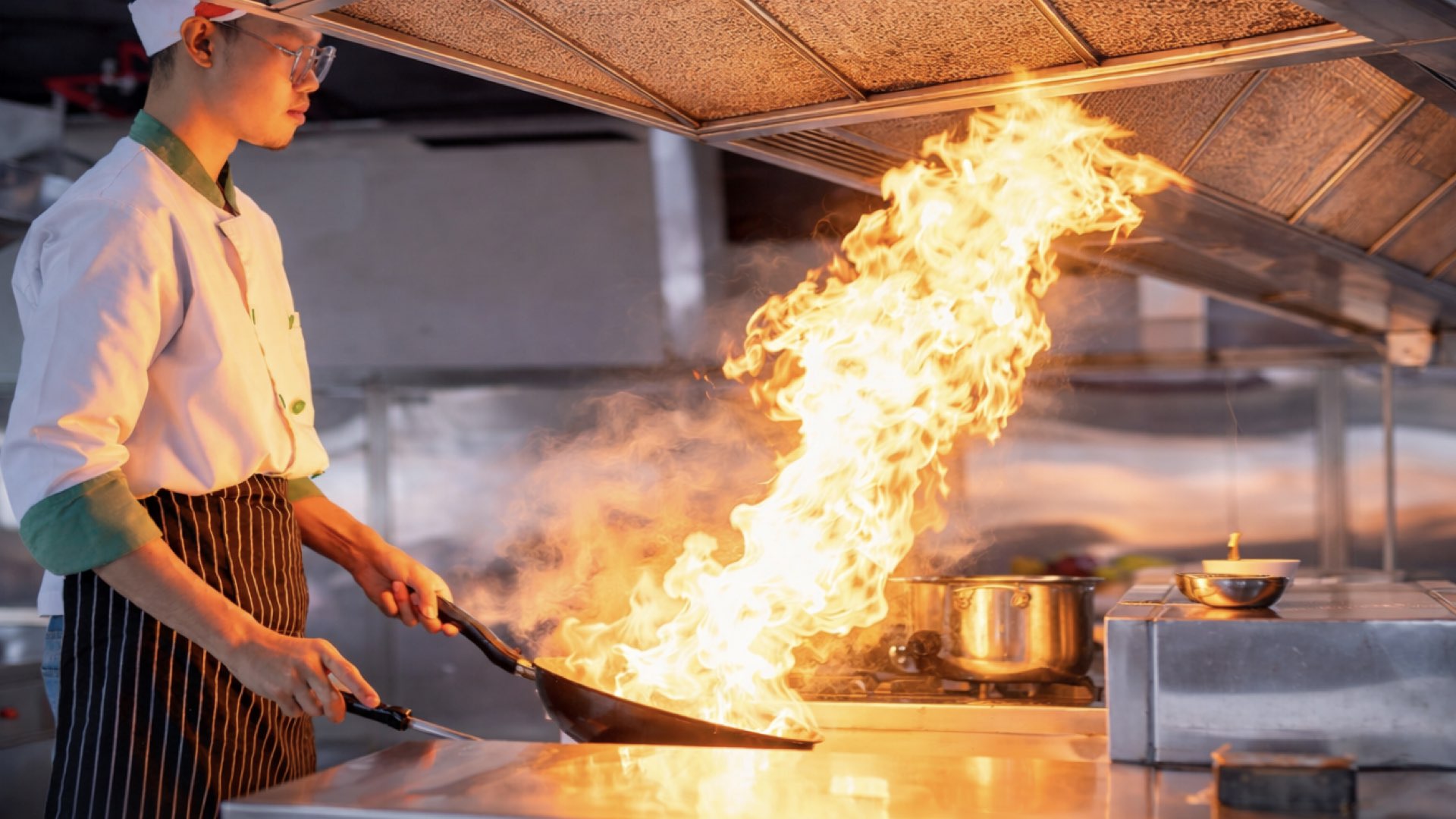
Knitted metal filters in commercial kitchens – fire-hazardous, banned and yet still in use! It’s hot in commercial kitchens every day. People fry, deep-fry and grill. This produces fat, oil and high temperatures. This is precisely why there are clear rules. And this is precisely why metal mesh filters are prohibited in commercial kitchens.
Nevertheless, you still see them. And very often.
Metal mesh filters in commercial kitchens – a dangerous part of everyday life
Go to large shopping malls. Or go to food courts. Or take a look in open kitchens. Then, unfortunately, you will see it again and again:
- Kitchen hoods with knitted metal filters
- Aluminum mesh filter
- Filters as we know them from private kitchens
But this is where the problem begins, because metal mesh filters in commercial kitchens are a fire hazard and prohibited!
Why metal mesh filters are prohibited in commercial kitchens
Knitted metal filters store grease and oil. And that is exactly what must not happen.
Because:
- Fat is highly flammable
- Oil burns very quickly
- Knitted filters promote fire
So if a fire breaks out, these filters cannot stop the flames. On the contrary: they let the fire through. And they also ex acerbate the fire.
The greatest danger: fire in the ventilation duct
Kitchen hoods are almost always connected to ventilation ducts. These ducts lead:
- from the kitchen
- through several floors
- up to the roof
If a fire starts in the kitchen and there is no effective flame protection , the worst can happen:
➡️ The fire spreads through the ventilation duct throughout the building.
This is precisely why the right kitchen filter is so important.
DIN EN 16282 – clear rules without leeway
The rules are not new. And they are clear.
- Formerly: DIN 18869
- today: DIN EN 16282
- additionally: requirements of the employers’ liability insurance associations
Everyone says the same thing:
👉 Knitted metal filters that store fat or oil are prohibited in commercial kitchens.
Type A flame protection filters are indispensable when it comes to the safe operation of kitchen exhaust air systems. This is because they prevent flames from spreading uncontrollably through the exhaust air system. They also retain grease particles so that no dangerous deposits can form inside the system.
In contrast, type B filters are not certified and are therefore unsafe. They do not provide effective protection against flame penetration and therefore increase the risk of fire. This is why the standard clearly requires the use of tested flame-retardant filters.
Our X-CYCLONE flame-retardant filters meet the requirements of DIN EN 16282-6 and therefore set standards in terms of safety. At the same time, they are designed in such a way that they separate grease efficiently and the separated grease is discharged into collection channels. This reduces the fire load in the entire system.
Download the ePaper on the X-CYCLONE flame protection filter here:
What DIN EN 16282 clearly prohibits
The standard prohibits:
- Aluminum knitted filter
- Knitted metal filter with fat storage
- Filters without tested flame protection
Why?
Because:
- they do not stop flames
- they do not prevent fires
- they greatly increase the risk
Combination separator – only under clear conditions
Yes, there are combination separators, i.e. elements that are half filter and half separator. But that doesn’t mean that everything is allowed.
Because they are only permitted if:
➡️ no grease or oil is stored in the filter.
As soon as grease or oil can remain in the filter, then apply:
🚫 Prohibited in commercial kitchens.
Privately permitted – commercially prohibited
There are often misunderstandings here. That is why clarity is important.
- private: allowed
- commercial: prohibited
Why?
Because:
- is cooked longer
- higher temperatures occur
- more people are at risk
The reality in Germany
Although the rules are clear, you can still see:
- Department stores
- Kiosks
- Restaurants
- Hotels
with kitchen hoods that do not comply with the rules.
This is not an isolated case. And that is no small problem.
Metal mesh filter commercial kitchen – a clear omission
What you see here is:
- Too little information
- Too little control
- Too little sense of responsibility
And that is precisely what is dangerous.
The clear stance of REVEN GmbH
We say it openly. And we say it clearly:
⚠️ Knitted metal filters in commercial kitchens are prohibited and a fire hazard.
Because fire protection is not an extra. Fire protection is mandatory.
Focus 2026 – education instead of looking away
That is why REVEN GmbH is setting a clear focus in 2026:
- Blog articles with clear statements
- Digital information brochures
- Live webinars with cci Dialog GmbH all information from January 2026 here: https://cci-dialog.de/reven-webinare/
Our goal is clear:
- More security
- Fewer fires
- Clear rules
- More transparency
Because one thing is certain:
🔥 Without suitable flame protection filters, every commercial kitchen becomes a fire hazard.
Transparency through REVEN: Video recordings visible to everyone
We at REVEN GmbH deliberately go one step further. We record every complete flame transmission test of our X-CYCLONE flame protection filters in accordance with DIN EN 16282-6. We then publish the videos on our REVEN TV YouTube channel.
This allows interested parties to understand exactly how the filters are checked and how they behave in an emergency. This is how we create trust, because we don’t just talk about security, we make it visible.
More than the standard: additional explosion tests
But we don’t stop at the prescribed tests. We also test our filters in explosion scenarios. We simulate how the filters behave in the event of a sudden pressure wave, which can be caused by flammable coolants or lubricants, for example.
The results speak for themselves: our X-CYCLONE flame protection filters withstand even extreme loads. They do not deform and reliably prevent flames or pressure waves from passing through the system in an uncontrolled manner. This results in a level of safety that far exceeds the standard.