








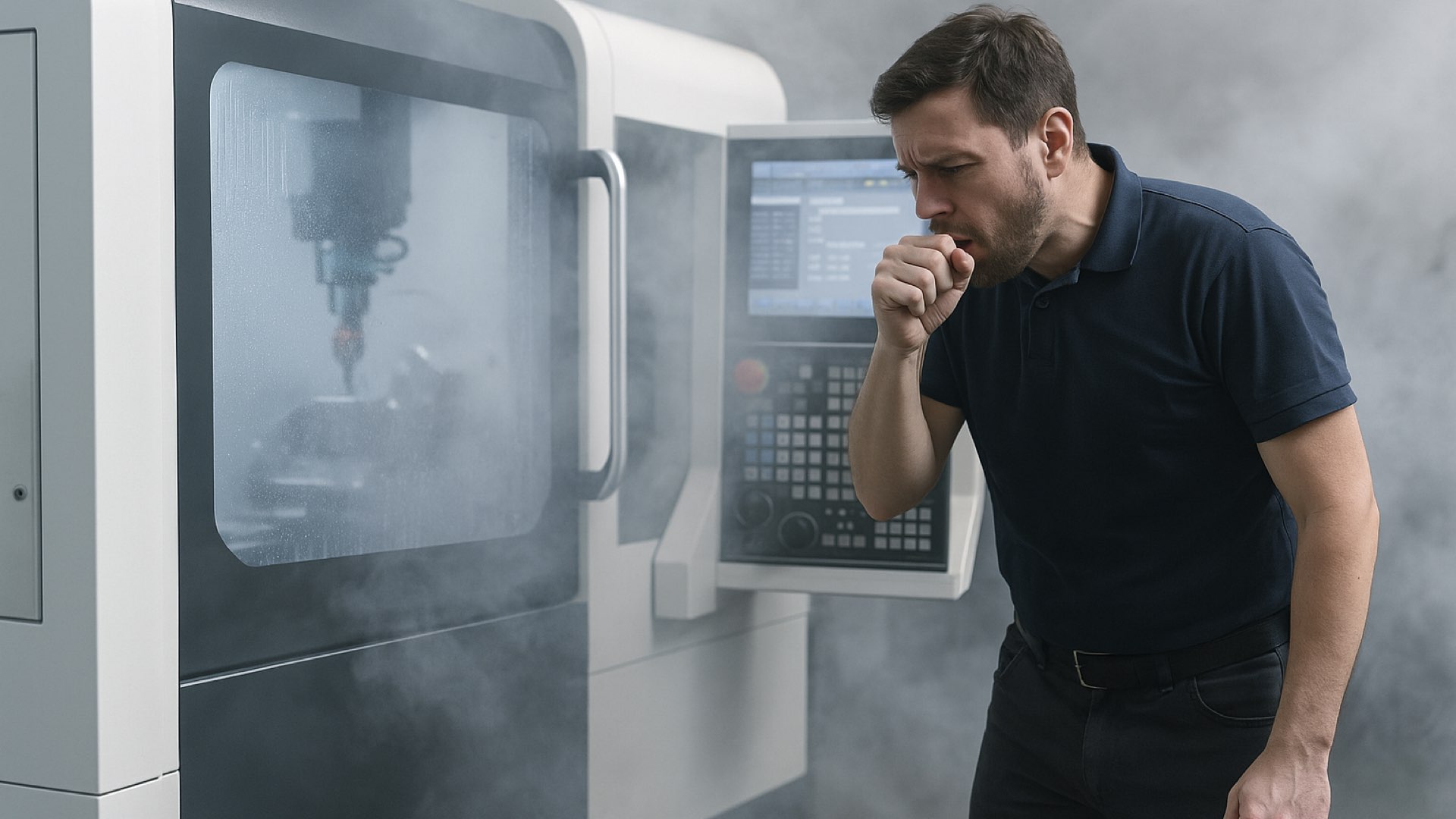
Air pollution control in mechanical engineering – the most important questions from our live webinar. Today, many modern workshops are home to high-precision CNC machines such as milling machines, lathes and grinding machines. And because these machines are working ever faster and ever more precisely, they are also generating more and more air pollution from oil mist, emulsion mist and fine particles. This is why air pollution control is becoming increasingly important in mechanical engineering, not only for clean air, but also for stable processes and safe workplaces.
This is precisely why we organized a large, Europe-wide live webinar. In this webinar, many questions came directly from the everyday lives of machine builders and machine operators. And because these questions are so valuable, we have summarized them in a short video. You can find the video embedded directly in the blog here.
So that you can read all the content in addition to the video, we have summarized the most important topics again in detail as a blog article.
Why air pollution control is becoming increasingly important in mechanical engineering
Many companies today have very different machine tools. And because each machine uses different machining processes, different quantities of oil mist and emulsion mist are produced. These substances must not simply remain in the machine or in the work area, but must be reliably extracted and cleaned.
After all, if too much mist remains in the machine, this can not only lead to dirty surfaces, but also to poor visibility, slippery floors or even technical problems with the machine. And because more and more companies are automating, clean air is becoming even more important to ensure that robots, sensors and cameras can work reliably.
Air pollution control in mechanical engineering – how much maintenance is really necessary?
One of the most frequently asked questions in the webinar was about maintenance. Many wanted to know whether modern air purifiers really are almost maintenance-free. And in fact it can be said that yes, most devices require very little maintenance.
And because modern separators are made of robust materials and are also very easy to clean, in many cases a simple visual inspection is sufficient. This saves companies a lot of time and money. What’s more, the air purifiers remain in use for a very long time without the need to replace parts.
Only if electrostatic filters are used and the machine works with low-viscosity oil do the collector cells need to be cleaned regularly. But here too, it is much more about cleaning and much less about replacing components.
How does the temperature in the machine remain stable?
The webinar also dealt with the question of how the temperature in the machine tool can be kept stable. This is because many precision machines only work one hundred percent accurately if the temperature inside them remains constant.
Many machine manufacturers therefore already supply a temperature signal that can be evaluated directly. And because this works so well, we can use it to adjust the fan output and control the air volume. As a result, the temperature in the machine remains stable and the machining accuracy remains high.
Air pollution control in mechanical engineering – what air volumes are possible?
The next big question was the length of the pipes and the air volume. Many wanted to know how far an air purifier can suck in and how far it can push the purified air.
And because every machine is different, there is no simple blanket answer here. But you can say:
Short lines are always better than long lines. And as long as you stay within the range of around two to five meters, most systems work very reliably.
However, if pipes become too long or if several machines are connected to a single appliance, the limits can quickly be reached. And because this is often underestimated, problems with the air volume occur time and again in practice.
Why separators and filters are two completely different worlds
One particularly exciting point in the webinar was the comparison between separators and filters. Many people think that both work in a similar way. But they are actually two completely different systems.
A separator needs a certain air speed to work properly. If the air volume is too low, the performance drops sharply and clouds of mist can form inside the machine. And because this can quickly become dangerous, a stable air volume is particularly important here.
A filter, on the other hand, will last the longest if as little air as possible flows through it. This is why filters appear to be “easier to clean” at first glance, but they often change the air flow in the machine to a greater extent.
These differences are important in order to select the right solution and to avoid planning errors.
Conclusion: Air pollution control in mechanical engineering is a real practical issue
The many questions from the webinar show very clearly how important this topic has become. And because modern CNC machines only work safely and precisely if the air cleaners are designed correctly, it is worth taking this topic very seriously.
Our webinar video summarizes the most important questions and answers and shows in a practical way where challenges arise and how they can be solved. And because we have embedded the video here in the blog, you can watch it at any time and forward it directly to your colleagues or customers.
If you have any questions about the planning, design or maintenance of air purifiers, we will be happy to support you personally.
👉For moreinformation and all technical details, see our Kofigurator product: