









Inhaltsverzeichnis
An in-depth look at air pollution in mechanical engineering. In chapter 6 of our new book “Misunderstandings in ventilation technology and air pollution control”, we take an in-depth look at the question: “How can air pollution be measured?”
This chapter is particularly important as it explains the various techniques and methods for measuring air quality and demonstrates how essential precise measurements are in mechanical engineering.
Air pollution and its components
For many years, there has been a consensus that polluted air is not healthy. The pandemic has shown how dangerous air contaminated with viruses can be. Polluted air can contain viruses and bacteria, fine dust, fungal spores, pollen, gases and vapors as well as particles and aerosols. According to the World Health Organization(WHO), air pollution has the greatest negative impact on human health worldwide. For this reason, the so-called PM standard was defined in the USA in 1987, which measures the proportion of solid or liquid particles in the air. These particles are often components of aerosols, which consist of a mixture of air and particles.
Misunderstandings about aerosols
A common misconception is that aerosols are simply referred to as particles. In fact, an aerosol is only formed in combination with the surrounding air. PM10 indicates the presence of particles with a diameter of 10 micrometers and smaller, which can consist of both solid dust grains and small liquid oil droplets. These definitions are important in order to take the right measures to keep the air clean.
The role of particle measurement
Particle measurements make air pollution visible and are crucial for proving the efficiency of ventilation systems. Particle counters use laser beams to analyze the smallest particles in the room air, count their number and determine their size. This technology is not only used in clean rooms, but also in production facilities and commercial kitchens. The particle concentrations in production facilities differ considerably from those in cleanrooms. In the past, we had to dilute the air to be analyzed with particle-free air in order to obtain precise measurements. Today’s particle counters, however, are able to analyze heavily polluted room air with high accuracy.
Measuring air pollution in mechanical engineering
Accurate measurement of air pollution is of crucial importance in mechanical engineering. Our aerosol separators at Rentschler REVEN GmbH are validated by the Fraunhofer Institute in Hanover. These validations show the degree of separation of our systems as a function of the inflow velocity and particle size. Our mechanical engineering separators are typically designed for air velocities of between two and three meters per second. At an inflow velocity of 2.5 m/s, the following degrees of separation result:
Particles 10 µm ~ 100%, particles 5 µm ~ 100%, particles 3 µm ~ 96%, particles 1 µm ~ 55%, particles 0.8 µm ~ 42%, particles 0.5 µm ~ 28%.
Practical example: Lathe
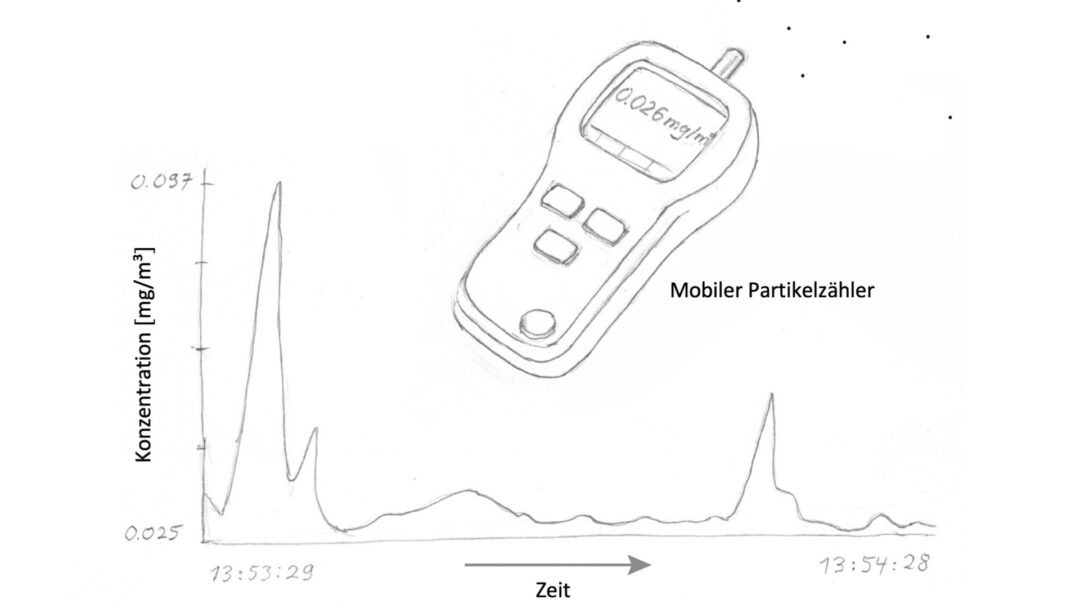
Let’s look at an example from practice: At a lathe, there is air pollution with a particle spectrum as follows:
Particles 10 µm ~ 30% (corresponds to 2 mg/m³), particles 5 µm ~ 30% (corresponds to 1 mg/m³), particles 3 µm ~ 20% (corresponds to 0.5 mg/m³), particles 1 µm ~ 10% (corresponds to 0.3 mg/m³), particles 0.8 µm ~ 5% (corresponds to 0.2 mg/m³), particles 0.5 µm ~ 5% (corresponds to 0.1 mg/m³).
The total particle spectrum amounts to 4.1 mg/m³. Our air purifiers can achieve the following degrees of separation and separate these from the air:
Particles 10 µm (2 mg/m³) at 100%: Residual 0 mg/m³, particles 5 µm (1 mg/m³) at 100%: Residue 0 mg/m³, particles 3 µm (0.5 mg/m³) at 96%: Residue 0.02 mg/m³, Particles 1 µm (0.3 mg/m³) at 55%: Residue 0.135 mg/m³, particles 0.8 µm (0.2 mg/m³) at 42%: Remainder 0.116 mg/m³, particles 0.5 µm (0.1 mg/m³) at 28%: Remainder 0.072 mg/m³.
The total residue of non-separated particles is 0.343 mg/m³, which corresponds to an overall separation efficiency of 91.6%.
Conclusion
Precise measurement of air quality in mechanical engineering is essential. Our scientifically sound methods and modern equipment enable us to validate and optimize the efficiency of our air purification systems. Accurate measurements of particle size distribution are crucial to ensure optimal air pollution control and protect the health of employees.
Our efforts are aimed at reducing air pollution in mechanical engineering and thus creating a healthier working environment. Our new book provides comprehensive insights into measurement methods and shows how important it is to have accurate particle distribution data in order to develop effective air purification solutions.